“How Can I Like Myself Better?”: An Inquiry into Self-esteem

We all probably have an intuitive sense that self-esteem is an important factor affecting our interactions with others, our readiness to deal with problems, and our pursuit of our goals: liking ourselves gives us the self-confidence to meet these challenges and to do so more effectively.  Yet self-esteem is a vague and elusive concept, one which is difficult to apply on a practical basis.  This article addresses what self-esteem is, what its qualities are, and how it develops, and then applies this understanding to the issue of how to work on our self-esteem in our everyday lives. 

 self-esteem image

What is self-esteem?

Essentially, self-esteem is a measure of how well we like ourselves.  It is the evaluative component of our identity, our value judgment of who we are – the various roles, values and attributes that we identify as our own.  It goes beyond pure description and decides whether these qualities are good to have.  Yet self-esteem is not just a judgment of our individual qualities or traits, but a valuing of the total self – positive or negative.

What if we’re not sure about how we feel about ourselves?  Sometimes we might feel really pleased with ourselves, yet other times we might feel embarrassed or even ashamed of ourselves.

That’s an excellent point.  How we feel about ourselves can change considerably from day to day, or even from hour to hour, depending upon our circumstances. This variability is a second aspect of self-esteem, after the value aspect of high or low self-esteem.  This variability will differ from person to person.  Some individuals’ self-esteem remains rather consistent across different situations, whereas others’ varies widely with changing circumstances.

Why is self-esteem more consistent for some and more variable for others?

The stability of self-esteem is related to the degree of integration and stability of identity.  If our sense of who we are is inconsistent across different situations, then our sense of self-worth is likely to fluctuate, as well.  If, however, we are able to maintain the “big picture” of who we are despite different roles or conditions, then our self-esteem is likely to be rather stable.

Another factor contributing to this variability is the degree our self-esteem depends upon others.  This dependence may take two forms.  The more familiar version involves relying upon the regular affirmation or approval from others to feel good about ourselves.  And on the negative side, it is the degree to which our self-esteem is vulnerable to criticism, disapproval, and rejection by others.  The second and less familiar version of dependence involves achieving self-esteem through our identification with people and organizations that we admire.  For example, we feel better about ourselves if our partner receives an award or our hometown team wins the championship.  Our self-esteem is attained vicariously , through our identification with those whom we admire. Conversely, we suffer a blow to our self-esteem when our heroes let us down – we experience their shortcomings as reflecting poorly on ourselves.  With either type of dependence, our sense of self-worth would tend to fluctuate more if it depends extensively on others fulfilling these roles, since they are not always going to be there for us, whether by approving of our actions or by living up to our expectations.  The independence of our self-esteem, the degree to which we have taken charge of determining our own self-worth in spite of how others feel about us or how they meet our expectations, will therefore affect its stability – something we will address later in the article.

Yet another factor affecting variability of self-esteem is whether it is primarily conditional or intrinsic.  Conditional self-esteem involves liking ourselves according to our being and acting in a preferred or acceptable manner.  Intrinsic self-esteem, however,  is a sense of self-worth for just being ourselves, without having to prove ourselves by meeting any particular goals or expectations.  It makes sense that this sort of self-esteem is more stable, since it would not be influenced so much by the normal ups and downs of our changing functioning.

What if we really don’t stop to ask ourselves how much we like ourselves – does that mean we don’t have much self-esteem?

Not at all.  Our self-esteem doesn’t have to be expressed in words or even put into thoughts to be active.  It is implicit in how well we treat ourselves.  You are no doubt familiar with the saying, “Action speaks louder than words.”  When we give ourselves a reward for a job well done, or when we ask for help on a demanding task, or when we take the last piece of cake, our actions are saying that we are valuable and deserving.  And when we let others manipulate us without saying anything, or when we don’t ask for something that is very important to us, our inaction is expressing our self-esteem, though in a negative way.  Of course, we often do make conscious judgments about ourselves in such circumstances, and the degree to which we do expresses our emphasis on self-esteem – yet another aspect of this concept.

So, is it good or bad to emphasize our self-esteem?

That depends.  Being self-aware is generally good, and that awareness can be either descriptive or judgemental.  Descriptive self-awareness pays attention to what and how we think, feel and behave, but doesn’t pass judgement on it.  The current practice of mindfulness cultivates such an awareness of self.  Judgmental self-awareness, in contrast, evaluates whether our thoughts, feelings and actions are good or bad, and this function thus can be useful for guiding our behavior.  But an excessive emphasis on maintaining positive self-regard can be disruptive.  We lose something when preoccupation with our self-image overshadows the various activities and relationships in which we are involved.  The extreme attitudes of “winning is everything” and “image is everything” generally dampen the intrinsic enjoyment of life.  These outlooks also tend to play havoc with relationships.  If we are preoccupied with our self-image, we usually require others to affirm our self-worth on a regular basis.  We would tend to view others primarily in terms of how they enhance our self-image, and this would cause us to neglect or overlook their feelings, needs, and wants.  Or we might require others close to us to meet exacting standards so that we can feel good about ourselves through our identification with them.  A common example of this is parents who pressure their children to be star athletes.  While they often make extensive sacrifices, this comes at a considerable price to the child.  Thus, constantly judging ourselves, whether directly or vicariously through others, not only can interfere with our intrinsic enjoyment of  activities, but also can disrupt our relationships.


But doesn’t this argument suggest that concern with self-esteem is bad and that it just increases self-absorption?

That’s a common misconception.  People often assume that the more we care about ourselves, the less we care about others.  Here it is important to distinguish between narcissism, with its emphasis on self-image, and healthy self-esteem, which is largely intrinsic and relatively independent of others’ approval.  With narcissism our self-image is largely dependent upon both our own accomplishments and others’ recognition of them, and we would tend to perceive others in terms of our own ego needs, rather than as individuals in their own right.  Healthy self-esteem, however, involves substantial faith in our intrinsic self-worth, so that it is less dependent upon the continuing affirmation of others. Thus, when we have a fundamental sense of self-worth, we are able to maintain positive self-regard even when in conflict with others we value, thus enabling us to respect their feelings, needs,  wants and opinions.  Where this intrinsic self-esteem is lacking, it is possible to work on self-esteem without requiring the submission of others, so that the integrity of others is respected as well.  We’ll address this issue when we explore how to work on self-esteem.


But can’t this self-awareness also be detrimental in focusing too much on our faults?

That’s right.  When used properly, self-awareness is quite enriching and useful.  It can simply enrich our lives by allowing us greater appreciation of our own involvement in our activities, pursuits and relationships.  Or it can function as a time-out in a sports competition, whereby we assess our part in a problematic situation and plan out a strategy to approach it differently to resolve the problem.  Yet quite often the self-reflection actually interferes with the planning and problem-solving that it is supposed to serve.  When that happens, we usually speak of someone being “too self-conscious.”

What is responsible for this misuse of self-reflection?

One important aspect is what we might call the “blame and shame” cycle, in which we get so caught up in blaming ourselves for a problem and feeling such intense shame that it interferes with our examining an issue in a realistic manner to find an effective solution to a problem or to understand the meaning a particular paradox may hold for us.  Self-reflection can be an effective tool for solving problems or recognizing paradoxes, but with such critical self-judgment, it often is counter-productive, even to the point of causing us to avoid problems or conflicts we really need to address.  Another frequent mistake is setting excessively high standards for ourselves.  So instead of shooting for a goal which is within reach, we might strive for an objective that is unrealistic or currently unattainable.

So, there’s a lot more to self-esteem than just being high or low, positive or negative.

That’s right.  In summary, we can speak of five different aspects  of self-esteem – value, variability, emphasis, dependence on others, and conditional vs. intrinsic typeValue is the most familiar to us, the positive or negative coloring of how we characteristically see ourselves.  The key word here is “characteristically,” since it implies some variability in self-esteem, which is  the second facetthe degree to which self-esteem fluctuates between highs and lows across time and situation.  The third aspect is the degree of conscious emphasis that we give to our self-esteem.  These three dimensions are affected by two other factors: first, the degree that our self-esteem is dependent upon others vs. its independence from influence; and second, the extent to which our self-esteem is conditional, dependent upon meeting certain expectations, vs. intrinsic, valuing ourselves just for being who we are without having to pass certain tests.  And problems in self-esteem can arise in some or all of these areas: our self-esteem can be generally low and variable, highly dependent on living up to standards and gaining the approval of others, while fostering an undue conscious emphasis on our self-image. 

Now that we have established what self-esteem is, how do we go about getting it?

Let’s start with how we attained our self-esteem in the first place.  Initially, we acquired our self-esteem through our parents and caretakers in two different ways, comparable to the two types of  dependence on others for our self-esteem that we examined earlier.  First, we learned to value ourselves according to the approval or disapproval of others, feeling good about ourselves with their praise and admiration and feeling bad about ourselves with their criticism and fault-finding.  The quality of these appraisals, whether they are intrinsic or conditional, is quite important for the development of our identity and self-esteem.  Intrinsic affirmation conveys our sense of worth for just being ourselves, whereas conditional affirmation is contingent upon our acting within a certain range of acceptable behavior.  We’ve all probably heard one or another version of the expression, “I love you, even though I don’t approve of your behavior.”  This is an example of unconditional acceptance of the person that builds intrinsic self-esteem.  With conditional affirmation our self-esteem tends to be less stable and to fluctuate with the perceived acceptability of our behaviour.  And with a fear of losing the approval of others, we tend to develop a “false self” that conforms to others’ expectations yet is untrue to our inner needs and feelings.

Another aspect of acquiring our self-esteem from others involves our identification with others whom we can admire and respect.  These people not only serve as role models to guide our development, but they also enhance our self-worth through our association with them.  In looking up to them, we feel better about ourselves.  Among other places, we witness this in the pride that people display in basking in the glory of their favorite sports team.

As is the case with our identity, we claim possession of our self-esteem when we challenge others’ appraisals of ourselves to determine our own self-worth.  Then our self-esteem becomes our own, gaining independence from the evaluations of others.

But don’t our parents and teachers need to correct us?  How are we going to learn anything if they don’t?

Yes, we do need help to learn from our mistakes, and we certainly need clear direction away from potentially dangerous situations.  Furthermore, the normal socialization process that helps us to develop our conscience and  moral values requires some disapproval of our behavior that violates the rights of others or simply neglects their feelings or needs.   Yet this disapproval often goes too far: frequently, it gets directed at the total self rather than at the problematic behavior, as we noted in the discussion of intrinsic and conditional self-worth.  The message may also be quite severe, such as “You’re stupid,” “You’ll never amount to anything,” or “You’re really disgusting.” We typically carry these messages with us well into adulthood, particularly if we have not also experienced more positive messages about ourselves to counter the negative evaluations.  These messages tend to be consolidated into an internal force with a life of its own, acting on us largely outside of our conscious control. After hearing these messages so many times, we  “internalize” them, or make them our own, to have available to say to ourselves when we let ourselves down.  This internalized condemning voice is sometimes referred to as the harsh inner critic, the punitive superego, or the internal saboteur.  Yet it usually doesn’t make sense to beat ourselves up for mistakes or shortcomings – after all, reality will probably punish us enough for our limitations.  But we aren’t always rational, especially when it comes to dealing with problems and frustration.

That may explain how someone got low self-esteem, but why would anyone continue to beat up on themselves?

There are several possible explanations for this.  For one thing, these self-messages tend to be well-learned and highly ingrained.  They don’t go away by themselves and they frequently return whenever we encounter some mistake or shortcoming on our part.  It may be easier to avoid dealing with the self-criticism than to challenge it.  Of course, as this often involves avoidance of the initial problem, it just makes room for more self-criticism, this time for the avoidance. The self-blame and shameful avoidance tend to feed off of each other in the “blame and shame” vicious cycle, reinforcing the pattern.   And as absurd as it may sound, there may also be some pay-offs that reinforce self-criticism.  Maintaining an extremely high standard for ourselves implies an attitude that we could meet that expectation, even though we may not be doing so at the moment.  Lowering the standards we set for ourselves thus implies a lowering of our sense of our own potential, and this disillusionment may be hard to accept.  Even if it is not a conscious choice, we might choose to berate ourselves for our current shortcomings rather than give up our illusions about our potential and admitting to our human limitations.  There may be a perverse pride that is involved in beating up on ourselves, especially if we don’t hold others to the same high standards.  For these reasons, this self-criticism continues as an major force that disrupts our self-esteem when we encounter our shortcomings.

This gets us to the question of how we can work on low self-esteem.  What can we do about the harsh inner critic?

We can start by paying attention to the kind of messages that we give ourselves, particularly when we encounter some shortcoming or mistake on our part.  We need to follow the dictum of “know your enemy” in trying to learn about the inner critic that gives us such a hard time.  We may be able to identify what critical messages we give ourselves rather easily, or we may have to work at uncovering the implicit message in the oppressive feeling and self-doubt that we experience.  The next step is to put the inner critic in perspective.  One approach is to explore where it came from: can we relate this message to any important figures in our past?  Giving the inner critic a name can create some psychological distance between it and ourselves, which gives us some perspective.  Next we can challenge the inner critic, and here it is important to enlist a helpful attitude, such as that of a supportive coach. With this outlook, we can both refute the berating message of the inner critic and propose a supportive, self-affirming message that expresses an acceptance of our human limitations while encouraging ourselves to move forward.  We can thus challenge the self-punitive side of ourselves, acknowledge our wounds from it, and re-focus ourselves from the “blame and shame” cycle back to the original problem or difficulty that evoked the self-blame.  We can also help give ourselves credit for the smaller steps that are required to complete a project, rather than berating ourselves for not getting it done right sooner.  This outlook can help us to accept our own human limitations and to view our shortcomings or mistakes as opportunities to overcome habitual patterns and to learn more adaptive responses to problems.

But isn’t there a risk that all this attention on self-blame and low self-esteem can increase our self-consciousness and make the problem worse?

That certainly is a valid concern.  Putting too much emphasis on ourselves can detract from the intrinsic enjoyment that we can achieve from participating in an activity or being in a relationship.  And interrupting our involvement in an activity or relationship for self-reflection interferes with the intrinsic enjoyment as well – even if that interruption is reassurance or praise.  The technique of challenging the inner critic is used most effectively when the inner critic has already done its dirty work of disrupting our involvement.  Then, it helps us heal our emotional wounds and get back out on the playing field of life.

Doesn’t this approach emphasize the conditional type of self-esteem?  And didn’t you say that this sort of self-esteem is less stable, since it is contingent on whether our current behavior is successful and appropriate?

That’s an excellent point.  For this reason, it is important to affirm our intrinsic self-worth, not just the value we earn through our accomplishments.  We need to develop an inner comforter and nurturer to complement the guide function of the supportive coach role we addressed earlier.  A popular expression of this is the use of affirmations that declare our intrinsic worth, such as “I’m OK the way I am,” “I deserve to be cared about,” and “I’m doing the best that I can, and that’s good enough.”

Telling ourselves such things is one thing, but the real test lies in how we treat ourselves.  Do we eat properly and get sufficient sleep?  Do we allow ourselves sufficient recreation, exercise and relaxation to relieve stress and revitalize ourselves?  Do we share our feelings with others and ask for their support and understanding, or do we bury them away and suffer in silence?  Do we claim the respect that we deserve from others, or do we tolerate their criticalness, name-calling, neglect, abuse, manipulation or coercion?  Do we usually put others’ needs ahead of our own?  And when we do tend to our needs, do we feel guilty about it?  How we answer these questions through our actions conveys implicit messages to ourselves about our sense of intrinsic self-worth.  What are we telling ourselves when we appease our emotional discomfort through outlets such as excess drinking, overeating or compulsive shopping?  Isn’t this somewhat analogous to offering candy to a malnourished child?  What are we saying about ourselves when we suffer alone in silence, or when we tolerate lack of respect?  All of our verbal affirmations will ring hollow unless we back them up with self-care:  action speaks louder than words.

Self-care sounds pretty simple, but it can also be quite difficult to carry out, especially if caring and support were lacking during our development.  If our parents and caretakers primarily valued us for our accomplishments and virtuous living to foster our conditional sense of self-worth, then they may well have neglected our emotional needs.  Not only does this neglect make it more difficult to access these feelings later on, but it often produces a buried store of hurt and anger which emerges as we start tending to our feelings.  Acknowledging our wants, needs, feelings and insecurities can help us to develop compassion for ourselves, as well as opening the door for others to understand and care about us.  But if we do not demonstrate caring for ourselves, how can we expect others to take our want, needs and feelings seriously?

This is all work that we should be doing ourselves, right?  It was all right to depend on others to help us with our identity and self-esteem when we were young, but we should do it for ourselves now that we are adults, to attain an independent identity. 

On the contrary, trying to do it all ourselves individually may be setting ourselves up for failure.  While pulling ourselves up by our own bootstraps is a noble idea, there may be something rather egotistical about trying to go it alone, without any help.  I probably overstated the ideal of an independent identity and self-esteem.  We continue to rely on others for feedback about ourselves, who we are and whether that’s good or bad, though we examine their input to decide whether to incorporate it into our identity or to dismiss it.  The more appropriate ideal may be one of an interdependent identity and self-esteem, rather than a predominantly dependent or independent one.

But what about your point that it’s not right to exploit others to boost our egos?

There’s a big difference between demanding others’ uncritical affirmation of our self-image and making use of their freely offered support.  The concern pertains to whether we view others exclusively in terms of enhancing our self-image, or whether we can appreciate them as individuals in their own right, with worthwhile needs, feelings, wants, aspirations, and accomplishments of their own, so that we can enjoy the intrinsic rewards of a reciprocal relationship.  Sheldon Bach’s recommendation that we balance our being-for-self with our being-for-others applies here.  We must also be ready to accept the fact that others are not always going to be there to affirm our identity and self-esteem – there will be times that they will not be available or will not be able or willing to fulfill that role in the way we would like.  For that reason, it is important to have a relatively broad support system, rather than depending exclusively on one person for our affirmation, and to be able to work on our self-esteem and identity by ourselves, when others are not available.  These provisions will lessen the likelihood of perceiving others primarily in terms of our own needs, whether those needs be of ego-enhancement or for understanding and support.  Then, we can establish intimacy, in which we share our vulnerabilities as well as our strengths with others on a reciprocal basis.

Now  that we’ve established that it is OK to rely on others to affirm our self-esteem, how can they help us?

The guidelines here parallel those of how we can help ourselves.  Others can affirm our intrinsic self-worth, regardless of our personal shortcomings.  They can show realistic admiration for our accomplishments or serve as healthy role models for qualities that we may wish to emulate.  They can give us honest feedback about how we come across to them, acknowledging our shortcomings as well as our strengths, while still valuing our basic self-worth.  Though this qualified support may be painful at times, it can also help us to give up our grandiose illusions of ourselves and to accept all of our human qualities, even when they represent limitations.  Others can encourage our continued efforts to work on our projects and relationships at the pace we are capable of, so that we can continue to develop our identities.  They can show appreciation for those times that we support their self-esteem and identity, and this gratitude can in turn enhance our self-esteem.

But what if we don’t really have people in our lives who are capable of providing this support?

First of all, don’t be too quick to discount others.  We may be inclined to assume that they should be able to give us what we need without our having to ask, but we need to challenge that assumption.  After all, we’ve listed a number of ways in which others can support our identity and self-esteem, and which ones we need at any given time may not be all that obvious.  It is true that others’ characteristic styles may not be that helpful:  some may condemn us for our faults, some may give advice when we need to figure things out for ourselves, and some may attempt to rescue us when we need to handle the problems ourselves.  Our specifying our own needs not only increases our chances of getting what we need, but it also presents others with the opportunity to develop themselves in ways that they may not have considered.

Still, there is the very real possibility that other significant people in our lives may not be able or willing to support our identity and self-esteem.  If we have self-esteem and identity issues because we experienced neglect or abuse during our youth, then we may have the additional burden of having chosen partners and friends who tend to be abusive or neglectful of our feelings.  While this may not make sense and we may berate ourselves for these choices, the simple truth is that we tend to choose that which is familiar to us, even if it is not that rewarding. We may need to work actively at developing a more supportive personal network.  This may involve joining a support group, and many are available that address problematic behaviors and addictions related to low self-esteem, such as alcoholism, drug abuse, anorexia, bulimia, codependency, gambling, compulsive sexuality, agoraphobia, or depression.  Psychotherapy can be a crucial asset, particularly in identifying the particular issues and conflicts involved in self-esteem and identity problems and in resolving them.  These options can be quite effective in helping to free ourselves from habitual patterns that thwart our evolving identity, but they also run the risk of emphasizing negative aspects of our lives.  For example, replacing an identity of alcoholic with that of recovering alcoholic is a step in the right direction, but it doesn’t go far enough.  We need to base our identity on where we are going, even moreso than on where we are coming from.  We need to define ourselves through activities and relationships that satisfy our inner needs and wants:  what gives us enjoyment?  what makes us happy?  We can use Joseph Campbell’s guiding principle of “follow your bliss” to direct our involvement with activities and relationships.  An effective approach to self-esteem requires a balance between pursuing our dreams, living in the moment, and staying alert to those pitfalls that knock us off course.

Balance seems to be a recurrent theme for healthy self-esteem.

That’s right.  We require substantial spontaneous, ongoing involvement in activities and relationships in order to feel alive and vitally connected to others, as well as a certain amount of self-reflection for the perspective and self-awareness to better understand our relationships and pursuits.  This understanding can help us to find a suitable balance between focusing on ourselves and on others, so that we are neither self-centered nor living out our lives through others.  Healthy self-esteem requires a substantial sense of our intrinsic value to lend it stability, as well as some conditional self-approval to motivate us to accomplish our goals.  A balance between a realistic recognition of our past accomplishments, a vital involvement in our present relationships and activities, and the pursuit of our aspirations for the future further supports our self-esteem.  Finally, a balance between independent work and use of others for support is an important aspect of our work on self-esteem which ultimately enhances our involvement with others:  with independence and mutual support we can better appreciate each other for ourselves, so that we can all take care of our wants, needs and feelings and work toward achieving our goals in life.

Dr. Bob Daniel is a Licensed Clinical Psychologist in private practice with Tidewater Psychotherapy Services in Virginia Beach.
Rationalizations Used To Minimize and Deny Substance Problems

Recognizing Rationalizations

We often use rationalizations to justify unhealthy activities we have difficulty giving up. This is certainly common with substance abuse. We may not even recognize how we are fooling ourselves with our excuses and alibis. If we can recognize our rationalizations, we might catch ourselves before doing further damage. By identifying common types of rationalizations, this blog seeks to support this understanding and to help prevent relapses.

Definitions and Examples

We start by defining “rationalization” and seven common types of rationalization. Note that “rationalization” is the all-encompassing or catchall category, and the other terms are specific types of rationalizations. We also provide examples for each of these types, to illustrate the concepts.

Practicing Identification of Types

We need to practice developing our recognition and understanding of how these rationalizations play out in our lives. For this practice, we have a multiple choice exercise. We ask our readers to identify the type of rationalization that best fits each of the twenty examples. Some of the examples may have two or three more-or-less correct answers, but we are looking for the best specific answer. In other words, you might hit the target, but we are aiming for the bull’s-eye. So, if you answer “rationalization” for all the examples, you would hit the target every single time. You’d still miss the bull’s-eye most of the time.

Of course, the practical application of this exercise does not require the identification of the specific type of rationalization. We introduce this aspect of the exercise simply to more actively engage the participant.

Translating the Rationalizations

The third column of the exercise is a challenge to the rationalization. This often involves a translation of what the rationalization really is saying, typically calling out its absurdity. I have attempted to introduce some humor into the translation or challenge as a method of helping the medicine go down. Recognizing our con-job on ourselves can be a bitter pill to swallow.

The Evolution of This Exercise

This exercise has evolved out of my years of doing substance abuse work in private practice. Several of the examples have come from actual responses given by my clients, whereas others have been adapted or modified from those responses. I have not given specific credit to those clients, as I wish to protect their anonymity. They should feel honored with the knowledge that it is plagiarism, not imitation, that is the highest form of flattery.

If therapists or counselors wish to utilize this exercise, they may do so with the proper recognition of credits.  I would ask that you identify me as the author and www.roguepsychologist.com as the source.

By the way, if you wish to have a list of the official correct answers for the exercise, you’ll have to leave a request in the comment section following the post, preferably with some constructive feedback.  This is just my way of encouraging the readers to interact more actively with this site.

Types of Rationalizations

Rationalization – an argument that is not quite relevant, used in order to explain away, excuse, or justify a behavior that really doesn’t make sense.
The following are various types of rationalizations, which often are used to justify substance abuse:

Minimization – minimizing or downplaying some aspect of your drug or alcohol use in order to underestimate the likelihood or seriousness of the problem (e.g., “What harm is just one more drink going to do, anyway?”)

Exaggeration – overestimating other aspects of a substance-related incident in order to lessen your own personal responsibility for causing the problem (e.g., “If I’d only fixed that tail light, I would never have been stopped and gotten that DUI.”)

Undergeneralization – failure to recognize the similarity between your own substance-related problems and that of others who abuse or depend on substances (e.g., “I don’t abuse alcohol. It’s not like I drink every day.”)

Overgeneralization – addressing your substance use so broadly as to overlook the particular aspects of it that cause problems (e.g., “Everybody overindulges now and then. I just got caught – that’s all.”)

Faulty Comparison – comparing your own substance problems, use pattern, or drug of choice to something worse in order to make your own problems or responsibility seen minor by comparison (e.g., The cops ought to be chasing the real criminals – robbers, murderers, rapists – rather than picking on ordinary citizens like you and me.”)

Projection of Blame – avoiding or minimizing your own personal responsibility for substance abuse by focusing either on how someone else caused you to behave that way (e.g., “Now, see what you made me do!”) or on how someone else overreacted or responded unfairly to your behavior (e.g., “Those cops hanging out at t/he strip are just waiting for you to slip up.”)

Denial – overlooking or refusing to recognize your substance related problem, which appears obvious to most people (e.g., the tobacco company executives stating to Congress that “no one’s actually proven that nicotine is addictive.”)

Examples

[table id= 3/]


My thanks to the various anonymous donors whose field research and expertise made this list possible. They should view my claiming this as my own work as the highest honor. As I always say, “Imitation is not the highest form of flattery – plagiarism is.” Would you believe that I came up with that saying all by myself!)

Cognitive Behavioral Therapy: Panacea, or Helpful Tool?

For decades, cognitive behaviorists have been touting their therapy as a cure for all kinds of emotional distress. In particular, this approach addresses how irrational thoughts often lead to emotional distress. Then, it challenges those beliefs, which can turn ordinary frustration and disappointment into emotional devastation. This post uses the syllogism to demonstrates that faulty logic through the use of a syllogism. Now, cognitive behaviorists rarely present their challenges in this form. This exercise simply presents their arguments in a more structured manner.

However, we should note that clients usually seek help for their emotional pain, and rarely for irrational thinking. Furthermore, irrational beliefs are not always the primary source of their suffering. Here, logical analysis is of limited value, and other approaches can provide more helpful measures.

The Syllogism – A Useful Tool

For centuries, logicians have used the syllogism to reach valid conclusions on the basis of available knowledge. In particular, this analytic device derives a logical conclusion from two premises, which are typically widely accepted or assumed. The major premise is usually a widely-accepted generalization about characteristics of a class of objects, people, events, etc. The minor premise is often a declaration that a specific object, person, event, etc. is a member of that class. The logical conclusion is that the specific case possesses the characteristics of the class to which it belongs. Within this framework, we can apply the generalizations to particular situations, such as our own life experiences.

The major premise may also be a generalization established from an earlier inductive logic. Such facts are established as through scientific research. The minor premise

Sources of Irrational Beliefs

Some examples of syllogisms can illustrate this deductive technique. For one thing, it can help us identify possible sources of false beliefs.  At other times, the problem lies in false premises or generalizations. At other times, the difficulty is one of faulty logic. Here, some of examples can be helpful.

Examples of False Syllogisms

EXAMPLE A

Syllogism involving False Assumption
  • Major Premise: Only stupid people make mistakes.
  • Minor Premise: I made a mistake.
  • Conclusion: Then, I guess I’m just stupid.
Syllogism involving Faulty Logic:
  • Major Premise: Stupid people make mistakes.
  • Minor Premise: I made a mistake.
  • Conclusion: Therefore, I must be really stupid.

Challenge to the Irrational Belief and an Alternative Conclusion: Everyone makes mistakes now and then, myself included. Maybe if I try learning from my mistakes, I won’t make similar mistakes in the future.

EXAMPLE B

Syllogism involving False Premise and Logic:

  • Major Premise: Alcoholics drink morning, day, and night.
  • Minor Premise: I never drink before 6 p.m.
  • Conclusion: Thank God I’m not an alcoholic.

Challenge to the Irrational Belief and an Alternative Conclusion: Since not all alcoholics drink all the time, maybe I should consider the possibility that I am a nighttime alcoholic, particularly since I’m so concerned that I’m not an alcoholic.

EXAMPLE C

Syllogism involving False Major Premise

  • Major Premise: All emotional pain is caused by irrational beliefs.
  • Minor Premise: I am really hurting over the death of my spouse.
  • Conclusion: Thus, I must be crazy.

EXAMPLE D:

Syllogism involving Faulty Logic

  • Major Premise: Irrational beliefs can turn normal disappointment into suffering.
  • Minor Premise: I am suffering.
  • Conclusion: Then, I guess I must be crazy.

Note that in the first example, the false belief (i.e., only stupid people make mistakes) and/or the faulty logic (i.e. assuming that I am stupid because I made a mistake, even though smart people make mistakes, too) result in an intensification of the negative self-assessment and its associated negative feelings, such as shame, self-loathing, discouragement, and frustration. This process can “make a mountain out of a mole hill,” whereas the challenge suggests recognizing “the silver lining around the dark cloud.” Note that the second example does not involve an intensification of a negative emotional state, but rather represents a denial of a problem that may well need attention.

Therapy’s Implicit Use of the Syllogism

If you have been in therapy with a cognitive behaviorist, you will recognize that he or she does not conduct therapy by translating beliefs and observations into syllogisms, even if that is the basic process underlying the challenge to one’s belief system. I provide these examples as a way of illustrating how cognitive behaviorists follow in the tradition of the logical empiricists, who view knowledge as attained through applying principles of logic to shared sensory experience.  As we will address later, not all challenges of living are problems which lend themselves to logical solutions, as life involves various paradoxes that defy logical solutions.

An Abridged Cultural History of Cognitive Behaviorism

For years, cognitive behaviorism has been a self-proclaimed leader in psychotherapy, citing numerous studies to back that claim. Its list of “evidence-based” applications has grown so broad that you’d think it’d cure all that ails you. Like other movements, it has tended to overreach its utility by trying to be all things to all people. We can gain perspective, though, by placing cognitive behaviorism in its cultural context. In doing so, we can better appreciate both its promises and its limitations in resolving particular problems of living. This exploration will allow cognitive behaviorism to assume its rightful place among other approaches to life’s adversities. We can then apply its strategies and techniques to the appropriate situations. Likewise, we may find that other therapeutic approaches are more relevant for other circumstances.

The  Broader Historical Background

Beginning with the Renaissance, Western culture has moved from a faith-based to a science-based view of reality. One profound trigger for this shift occurred when Copernicus and Galileo challenged Christian orthodoxy by proposing a heliocentric universe. The entire culture appeared knocked off balance by the idea that the Earth revolved around the sun. he changes in perspective have been so profound that conventional thinking has been questioned. In doing so, our civilization has developed a bias for an objective perspective toward our world. Philosophy has reflected this movement, with its schools of rationalism, empiricism, and skepticism.

This shift has fostered the Industrial Revolution, with its unprecedented advances in science and technology. However, the objectivity of science has been less beneficial in understanding and improving the human condition.

We have witnessed such a drift toward objectivity in the emerging field of psychology. Here, the scientific method works fairly well in analyzing human behavior, but less so in understanding human experience. This has led to the developing school of behavioral psychology, with its emphasis on publicly verifiable data. Eventually, some behaviorists recognized that private experience offered some benefit toward understanding human activity. This realization spawned the school of cognitive behaviorism. While it delved into the realm of subjective experience, this movement still retained an objective bias in analyzing it. More recent developments within this approach have struck a more equal balance in considering both behavior and experience in seeking an understanding of the human condition. This post will explore this evolution in more detail.

Logical Empiricism

The emergence of logical empiricism reflects this growing objectivity within philosophy. This approach is not so much a philosophy of life as it is a philosophy of science, with its primary focus on knowledge rather than values or principles. With its inquiry into epistemology, our quest for knowledge, it evolved as a philosophy of science. This approach views knowledge as being accrued through applying principles of logic to shared sensory data. From this perspective, personal experiences are not to be trusted unless they can be validated by others. The logical empiricists considered metaphysical constructs non-sensory, (or nonsense?), and thus unworthy subjects for philosophical or scientific analysis.       This was in contrast to other schools of philosophy, with their focus on  values or principles.

Psychology’s Break from Philosophy

Psychology has bought into this objective bias through adopting an experimental methodology for establishing knowledge. Still, much of the subject of this inquiry was private experience, which was ascertained by simply asking about it. It designed controlled experiments to demonstrate the cause-and-effect relationships between various abstract factors. This field of study thus broke from philosophy by emulating the rigors of the natural sciences, perhaps to attain cultural legitimacy.

Enter the Behavioral School of Psychology

The behavioral school evolved a more rigorous methodology, with its emphasis on observable data and verifiable findings. Behavioral psychology follows this approach in utilizing a linear, cause-and-effect analysis by focusing on behaviors as conditioned responses to stimulus situations. Private sensory experience, since it could not be externally validated, was considered irrelevant. The mind was thus considered a “black box,” something that either could not be penetrated through our understanding, or that did not offer any explanatory benefits. Case studies  fell out of favor, often dismissed as subjective anecdotes, lacking in validity. With  this emphasis on objectivity, behavioral psychology has largely relegated the study of the complexities of the human experience to the arts and humanities.

The Emergence of Cognitive Behaviorism

Cognitive behaviorism, perhaps the prevailing model of psychotherapy for our time, has its roots in behaviorism. This approach is not so much a philosophy of life as it is a philosophy of science, with its primary focus on knowledge rather than values or principles. Cognitive behaviorism, though, reintroduced private experience as a legitimate object of inquiry, yet it still maintained the emphasis on logic. In particular, it posited irrational beliefs as the primary source for psychological distress. Thus, it rediscovered the experiences of the subject and assessed the validity of the subject’s interpretations or conclusions about those experiences, based on the standards of logic and reason.

CBT’s  Challenge in the Larger Historical Context

In assuming this approach, it was extending the challenge that the Age of Reason posed to the Age of Faith from the broad cultural level down to the individual level. In this case, rather than challenging the dogmas of religion, as Copernicus and Galileo had done in displacing the earth from the center of the universe, cognitive behaviorists were analyzing and challenging the idiosyncratic belief systems of the various individuals seeking their aid and counsel.

Objectivity vs. Subjectivity

Note that cognitive behaviorism is based on the primacy of objective reality, which tends to be equated with the external reality and has the connotation of being impartial, neutral, factual and absolute, whereas the subjective viewpoint is often judged to be biased, arbitrary, relative, and idiosyncratic. This perspective is usually implicitly assumed, such that other plausible viewpoints are not considered. For example, one might view objectivity and subjectivity as two contrasting modes of experiencing the world, rather than equating objectivity with the “real world out there.” Such is the motif of the realist and the romantic, or the pragmatist and the idealist, with our culture tending to value the former over the latter.

CBT’s Challenge to Freudian Psychology

A contextual review of the historical development of cognitive behaviorism would not be complete without reference to Freudian psychoanalysis, a prevailing model of psychotherapy from a previous era. Freud and his followers had upset Victorian sensibilities by introducing human sexuality into their lecture halls, consulting rooms and social parlors, thus creating considerable unease in polite society.

CBT’s Challenge to Freudian Psychology

Behaviorism did not challenge the Freudian psychodynamic model on the grounds of its emphasis on sexuality per se, but rather for its use of various metaphysical constructs (e.g., libido, the Oedipus complex, the death instinct, the unconscious), suggesting that they were so abstract and removed from the basic sensory experience of daily life that they could be neither proven nor refuted. Thus, behaviorism did not so much disprove Freudian psychodynamics as it relied upon the standards of logical empiricism to dismiss the case on procedural grounds. In this way, cognitive behaviorism was able to sanitize the animal nature in the human condition without getting its hands dirty.

Irrationality and Distress

That still left the realm of the emotions to address, since clients were seeking therapy and counseling, not to correct their irrational belief systems, but rather, to alleviate the pain and suffering they were experiencing. While the Freudian psychodynamic model views emotions as a manifestation of frustrated instinctual drives, cognitive behaviorism considers distressing emotions as byproducts of irrational belief systems.

An Alternative Perspective

Now, where am I going with this review? What’s my angle? You might note my domain name is roguepsychologist, and wonder what I am up to. And you would be right! In placing a perspective within a cultural context, we recognize its relativity – its place among others, and thus its limitations. Such is my strategy in challenging the position of cognitive behaviorism as the prevailing model of psychotherapy. And I would not be exerting such energy in this endeavor if I did not have my own perspective to set forth. And in doing so, I would pose the following question: what if the structure of our reality were not logical and rational? What if it were paradoxical, instead? And if so, how might we engage it, not in the most reasonable way, but in the most enriching manner?

For Further Exploration . . .

If these questions appeal to you, you may want to review my overview of the website, entitled About “A Rogue Psychologist’s Field Guide to the Universe” on the front page of this site, or explore a somewhat more detailed account for this quest in Beyond Rationality and into the Realm of Paradox.  I have now added two other pages, entitled Living Rationally with Paradox:  Keeping Sane in a Crazy World, or Trying to Fit a Round Peg into a Square Hole? and Muddling Down a Middle Path: Wading through the Messiness of Life, which explore this issue in more depth.

Wants and Needs vs. Shoulds

There’s nothing quite as effective as obligating yourself to something for turning play into work, especially if you put a schedule or a deadline to it. I found that out quite early in my blogging career, with my setting a goal of posting a blog each weekend. Here it is Weekend Two, with my having plenty of ideas in mind, as demonstrated by my Preview of Coming Attractions: Blogs under Construction, and yet I am obsessing about what to put out. Of course, having difficulty finding and retrieving past files and navigating HTML and the blogging platform doesn’t make it any easier. Still, I am left with the question as to why it is so easy to change something that I want to do into something that I have to do. When I make something a “should,” I am externalizing the control, with my responding to what I perceive as an external demand, even if it did originate with me. And with my being somewhat of a rogue, and therefore closer to the individuality pole of the individuality – belonging continuum, I tend to resist this force, even if it is largely internalized. (This pattern will be addressed in more detail in my upcoming blog regarding the critic – victim/rebel vicious cycle pattern.) When I stopped to realize just what was going on, this gave me a sense of liberation, since I now recognize what I was dealing with. (By the way, I owe a debt of gratitude to Hugh Livingstone, the sculptor in The Eskimo Who Lost His Art and Soul, who experienced with a similar struggle with his sudden fame.) So, part of my resolution is to use this struggle as fodder for my blog, following the adage, “If life gives you a bowl of lemons, learn to make lemonade.”

Still, this does not present a broader answer to the dilemma of living in the shadow of the “should”s. In exploring this issue, I am recognizing that the answer is not simply a clear-cut matter of authenticity, or “being true to oneself.” If I want to communicate with others, I must speak in a language that they understand and I must establish some predictability in order for others to come find my messages. These involve at least two different polarities, that of “being there for myself” versus “being there for others,” and that of order versus freedom. These both involve paradoxes, as empirical data and logic will not tell me just exactly where I “should” be on either of these continua. This realization brings with it a certain freedom, and yet a certain responsibility, as well.

 If I am to reach other people in a meaningful way, I must be willing to sacrifice a certain degree of my “being there for myself,” or selfishness, as well as a certain degree of my freedom. If I were to make such sacrifices out a sense of duty or obligation, I would likely view these constraints as an encroachment on my liberty.  I would then feel rather oppressed, or perhaps repressed, if I were not aware of these forces. If, on the other hand, I were to make the sacrifices out of a sense of love or caring for others, I would more likely experience compassion, rather than resentment. Then, these concessions of my “egocentric imperative” (i.e., having everything on my terms) for the greater cause of sharing would still be authentic, as it would express a genuine “being there for others.” Then, I would still be doing what I want, rather than what I think I should be doing.

Another factor in the oppressiveness of “should”s has to do with our living up to certain expectations, which are also frequently experienced as external, even if they originate within ourselves. This is where we can be our own worst critics. I am not going to make specific recommendations in this blog post as to how to deal with this predicament; rather, I will point you to my story of The Man with a Monkey on His Back.

In reviewing this blog post, I recognize that I am utilizing my perspective on the paradoxical nature of the human condition without having previously laid the conceptual groundwork. While this shortcoming may impose some limits on your understanding of this entry, it provides a concrete example of this process being played out in real-time, as I am composing the blog post. Hopefully, it will also stimulate your curiosity to pursue these issues in more depth in the coming weeks and months. I also invite you to share your own examples of such dilemmas, yet with a caution that I may post your comments on my website, unless you request otherwise.

About “A Rogue Psychologist’s Field Guide”

A Rogue Psychologist’s Field Guide offers a practical perspective for addressing the inevitable stressors of daily life. At times, this endeavor involves a logical process of finding specific solutions to life’s problems. Yet, at other times, we encounter life’s paradoxes. By definition, these defy logical solutions. These include the conflicting values of individuality vs. belonging, order vs. freedom, security vs. adventure, and being vs. becoming. Here, we must strike a balance for ourselves, without clear-cut standards to guide us.

A Guide to Conflict – A Path of Growth

Thus, life often presents us with messy dilemmas. While we often view conflict negatively, this Field Guide promotes the positive aspects of conflict. On the individual level, we achieve personal integration through reconciling our opposing feelings, values, and goals. And on the interpersonal level, conflict allows us to balance asserting our self-worth with caring for others.

On Problems and Paradoxes

By distinguishing between problems and paradoxes, the Field Guide offers a counterpoint to cognitive behaviorism, a self-proclaimed leader in psychotherapy. By emphasizing rationality as guiding our actions, that approach applies the objectivity of science to our personal lives. While the Rogue Psychologist recognizes logic’s legitimate role in solving life’s problems, it goes beyond that. By noting the paradoxical nature of various human conflicts, it draws upon the rich subjectivity of the humanities. This model thus complements science’s objectivity with the humanities’ subjectivity, providing a more comprehensive approach to life’s problems. This complementarity contrasts with a Western view of an objective reality that gets tainted by subjective distortions and biases. In proclaiming the limitations of objectivity, this approach also challenges conventional authority. Here, think of Toto pulling the curtain back on the Wizard of Oz. Only by challenging such authority do we empower ourselves and assume our personal responsibility.

Psychology for Professional and Lay Audiences

Another feature of the Field Guide is its attempt to avoid “psychobabble.” The ideas are often complex enough without couching them in jargon. Therefore, I try to present psychological insights in daily language to make them more accessible to lay audiences. Furthermore, I hope to appeal to other mental health professionals by expanding our perspective beyond rationality. Perhaps the portal of paradox can lead into the realm of enchantment, enlivening our experience. I find these dual objectives rather challenging, yet worthwhile, even if only for my own experience.

Acknowledging a Broader Realm of Paradox

This Field Guide emphasizes the paradoxes of our daily life in the interpersonal universe. This lies in contrast to those paradoxes of our much larger physical universe. While I am intrigued by such explorations, particularly when they point to a confluence of science and spirituality (cf. The Tao of Physics by Fritjof Capra, The Quantum and the Lotus by Matthieu Ricard and Trinh Xuan Thuan, and the website Science and Non-Duality), I prefer staying closer to home with our paradoxes of everyday life. Hopefully, that will help keep me grounded.

I wish to identify two particular works in which I have explored the paradoxical nature of human experience. They are Living Rationally with Paradox  and Muddling Down a Middle Path. These approach paradox from somewhat different perspectives, which hopefully promotes depth perception through stereoscopic vision (no 3-D glasses required!).

A Guide to Vicious Cycle Patterns

Another main focus of this Field Guide is the dynamics of conflict. Of particularly interest is the role that vicious cycle patterns play in sustaining conflict in interpersonal relationships. We will also be exploring how we can get stuck in unhealthy relationship patterns. These interactions involve trying variations of the same approach and yes, still expecting different results. We will explore various vicious cycles, including the classic Drama Triangle of Critic, Victim, and Rescuer. Then, we can identify various guidelines for breaking out of these vicious cycle patterns. This work has its hazards, and I should warn you of potential side effects, such as experiencing humility, compassion, gratitude, and emotional intimacy.

Two of my works are central to vicious cycle patterns. I have introduced this topic of unhealthy relationships in Vicious Cycle Patterns in Relationships 1.0. A more detailed exploration is presented in my article, “Vicious Cycle Patterns in Relationships 2.0.” Further works elaborate on particular vicious cycles and various strategies for breaking out of these unhealthy patterns.

Sources for the Field Guide

My Field Guide has evolved out of various public presentations I have made over the years.  Many of my upcoming posts will be elaborations or spin-offs of these presentations. And some will be an outgrowth of my dissertation. Here, I plan to delve more deeply into the complementarity of objectivity and subjectivity in their various forms. These include science and the humanities, Western and Eastern perspectives, and Yang and Yin. These serve the goal of integrating various perspectives into a coherent view of the human condition. Consistent with my advocating the value of subjectivity, I have posted several of my therapeutic stories. All these represent the continuing evolution of  my outlook during my fifty-some years studying psychology.

A Personal Note

In identifying myself as a rogue psychologist, I am simply acknowledging that my orientation runs counter to the prevailing cultural and psychological emphasis on rationality. I am not denying the positive contributions of logic and reason. In fact, I actually present articles that explores the helpful application of the cognitive behavioral approach. Yet I do not hesitate to point out its limitations, particularly in the realm of paradox.  This sets the stage for what I identify as a dynamic existential approach to our paradoxes of everyday life. 

I plan to submit posts on about a regular basis, though I have not been consistent about it. If you like what you see, you can help motivate me by leaving feedback – whether supportive, challenging, or simply acknowledging. Any of this helping to motivate my efforts. You can also subscribe to the website, so that you will be notified when I’ve posted new articles. I want this to be an interactive site, in which I can respond to the interests of the readers, but I cannot do so without your feedback. Hopefully, the above mission statement has whetted your appetite for more. So if these ideas appeal to you and you want to explore an alternative vision of the world, climb on board, hang on tight, and enjoy the ride.

How can we stop beating up on ourselves?

THE MAN WITH A MONKEY ON HIS BACK: A STORY OF THE STRUGGLE WITH SELF-BLAME

by Bob Daniel, Ph.D.

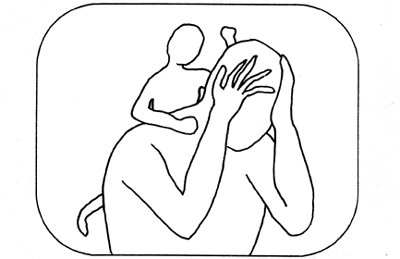
There once was a man with a monkey on his back – well, not a real monkey, but he thought it was real – at least, I think he thought it was real. (But I’m getting ahead of myself now.) Anyway, he came to me to help him get rid of his monkey. It wasn’t just his having this monkey on his back that was the problem – he could probably handle that. Rather, it was how his monkey treated him – that is, if you believe his story. He complained about how his monkey kept a running commentary on his life, and it was all negative. For anything that he would do, say, or even think, his monkey always found something bad to say about it: he was always too stupid, clumsy, too lazy, too weak, too immature, too crazy, or whatnot. Everything he did, he messed up in one fashion or other, and he always felt the harsh scrutiny of his companion. Finally, he reached a level of desperation he could no longer tolerate.

It was at this point that he found his way to me in his quest to rid himself of his monkey. Now I did as I usually do when seeing a new patient – I took his social history. When I got around to asking him about how long his monkey had been with him, he told me that he couldn’t remember ever being without him. He then recalled how he had told his classmates about the monkey. Nothing he would say could convince them of the reality of his monkey. And the way they ridiculed and teased him when he mentioned it rivaled even the monkey’s worst criticism. So he learned the hard way not to complain about his monkey. It wasn’t long before he stopped trying – he even scoffed when someone brought it up. “Monkey?” he’d ask, “What monkey? There ain’t no monkey. You got to be crazy!” After enough denial, he himself even questioned whether this monkey actually existed. So he bore the judgment and ridicule in silence, until he could stand it no more.

At this point, though, he had no doubt about the reality of his monkey. While he trusted me with his secret, he staunchly maintained this conviction. As we psychologists often do in such circumstances, I challenged the reality of his irrational beliefs. First, I asked whether others saw his monkey, to raise doubt in his mind. He paused, before replying, “No, I can’t recall that anyone else ever has.” When I asked what this suggests to him, he responded, “I don’t know, Doc, but you’ve got to get rid of him for me.” Then, I got much the same response when I asked whether anyone else ever heard his monkey. All he wanted to know was if I’d rid him of his monkey.

At this point, I decided to play my trump card, “You say your monkey criticizes you for what you do or say or even think? Now, how does your monkey know what you’re thinking? He can’t read minds, now, can he?”

He paused for quite a while, then spoke, “I don’t know how it works, Doc. It’s just like the monkey says – that  I’m too stupid to figure it out. All I know, is that you’ve just got to get rid of him for me.” Well, so much for my “gotcha” question.

Having been unsuccessful at probing and challenging his reality, I felt stuck as to what else to do next. So I did what most self-respecting psychologists do in such situations – I referred him to a psychiatrist, who could prescribe medication to rid him of his hallucinations. He was excited about this prospect and readily agreed to the appointment. So he showed up for his appointment as scheduled, and I saw him about a week later. When I asked him how the medication worked, he replied, “Nah, it didn’t do any good at all.” When I asked him how long he had been taking it, he appeared perplexed, “What do you mean, Doc? I thought the pills were for the monkey. And I couldn’t get him to take them.” When I explained that he was to take the medication himself, he appeared startled. He was quite mistrustful about being drugged, and he simply could not understand how taking the medication himself would make the monkey go away.

He repeated his request that I rid him of his monkey, and then he asked me to perform an exorcism. I attempted to refer him to a priest for such matters, with no success. He explained that he had already tried that route, to no avail: the priests limit these rituals to casting out devils, and his monkey posed a more secular dilemma. Having no other options in mind, I returned to my drawing board. Eventually, I cooked up a half-baked plan to perform a ritual. In part, I drew upon my knowledge of hypnotic techniques for this procedure. During my graduate class in hypnosis, I had succeeded in inducing a negative hallucination (i.e., an inability to see an object which is actually there), so this background offered some plausibility for success. Maybe I could induce an inability to see an object which is not there! I studied up on esoteric rites, and agreed to perform an exorcism, even though I knew very little about such procedures and I doubted my own ability to pull it off. I figured that the ceremony might do him some good, and probably would do no harm. After all, it was hard to imagine him being any worse off than he already was. And if it somehow worked at ridding him of his phantom, the procedure might provide some relief, even if he still believed in his monkey.

The exorcism worked beyond my wildest expectations. The next week he reported that his monkey had totally vanished, and that he experienced freedom as never before. There was no one to put him down or tell him how he messed up. While he was ecstatic, I was more cautious, asking him to return the following week. Then, he still appeared content, though not quite so excited. The next week he appeared rather bland, and then downright miserable the following week. Eventually he seemed about as depressed as before, and I had much less access to his problem than before. After all, at least as long as he experienced the monkey with him, I could question that. But how can you effectively challenge a belief in a monkey that had disappeared? Still, I had to probe, so I asked him what was the matter. He confessed that he was lonely and aimless, and that he missed the monkey, his closest companion. Even with all the abuse, the monkey had stayed with him and had given him a sense of direction, even if he could never seem to follow it. Without his monkey, he was utterly lost. At this point, I encouraged him to stay with his grief and assured him that he would eventually feel better after mourning his loss.

Well, the following week the man returned in better spirits. Naively, I assumed he had somehow turned the corner and I confidently asked him what had happened. He sheepishly looked away and sighed, “He’s back – the monkey.” With his head lowered, he finally admitted, “I invited him back.” I was torn with doubt – perhaps my excursion into magical ritual had been foolhardy, and I should have stuck with my traditional therapeutic tools. On the other hand, I could once again challenge his delusional belief in the reality of his monkey. Still, I realized that I would have to wait until he again felt sufficient distress to want to rid himself of his monkey, whether real or not. I didn’t have long to wait, for in a couple of weeks he was just as despondent as before. Again, I applied all of my challenges involving empirical tests, consensual validation and logic. I remained hopeful that such reality testing would dispel him of his delusional notions. Alas, it was all futile, just as before. He again asked me to rid him of his monkey. Having again made no headway with my usual methods, I figured that I might have greater leverage in granting his second request. I again agreed to perform the exorcism, but only under the condition that he agree not to invite the monkey back. I explained that he would have to mourn the loss of his fiendish friend before he could eventually settle into his more solitary existence. He agreed, and I again performed the exorcism, still unsure of the outcome.

To my surprise the procedure worked a second time: the man was again happy, though not as euphoric as before. And in the succeeding weeks the happiness gradually faded into despair, as before. But this time he persisted, though not without complaint. He pleaded with me to tell him what he should do, and he was obviously frustrated when I refused to answer or simply suggested that he should just wait it out. Sensing his pain and desperation, I finally relented and offered what I considered to be a few helpful suggestions for stress management and emotional regulation, but they only backfired. When he found that he couldn’t follow them successfully, he felt terribly inadequate. He was sure that I was despising him for his shortcomings, even speculating that I had gotten somehow in cahoots with his monkey. I had almost gotten stuck in the web of paranoia that I had implicitly condoned with the exorcism experiment. Still, I managed to extricate myself by observing that he was treating himself just as badly as his monkey ever did and that he was assuming that I would do the same. This reassured and comforted him, and he again promised to try my suggestions.

The following week he returned, glaring and fuming, reporting that he had tried my techniques and that they were utterly useless. He accused me of gross incompetence and quackery. With the failure of my unorthodox measures, I was now doubting myself. Then it occurred to me that this must be how he continuously felt with his monkey on his back. I must have muttered this under my breathe, for he remarked, “You get it, Doc.” A burden was now lifted from both of us, and he again vowed to persist in his struggle to endure without his monkey.

After a few more weeks his mood improved, and he appeared relaxed and free. I was again pleased with the results, though more cautious about my assumptions. So I asked him what happened. And again he gave me that sheepish look and lowered his eyes. He must have read the dismay on my face, for he reassured me, “No, not the monkey.” After a pause, he beamed, “It’s my fairy godmother.” I was crestfallen, for I felt I had only entrenched him further into his psychotic world. It was little comfort to me that his phantom friend was now a more benign creature, for she would be even more difficult to dislodge.

The man saw my shock and dismay, despite my efforts to hide my reactions. He tried to reassure me, “Doc, thank you for your tremendous help. Whereas I had the burden of an abusive monkey as my constant companion, now I have a helpful, supportive fairy godmother. Sure, she doesn’t tell me exactly what I should do, but she does give me confidence for making my own decisions. Even when I make a mistake, she is supportive. She even asks me what I might learn from it. Sure, it’s difficult not having the sense of direction implied by my monkey’s criticism, but I’m learning to accept that. I’m even enjoying a sense of adventure in not knowing the right way, and surprise with not knowing what to expect. Yes, it was even more difficult to deal with the loneliness after the monkey left and before she came. The silence, day after day, was unnerving. I longed for some voice, any voice, for company, if not for direction. If it weren’t for you, Doc, I would have gone back to that monkey. But you encouraged me to persist, until I found my fairy godmother. I’ll be eternally grateful to you, and I want to let everyone know what you’ve done for me.”

While I was pleased with his apparent improvement, it also raised my apprehension. I imagined his unsolicited testimony reaching my colleagues. I then fantasized their amusement over this so-called “success,” which actually involved my patient becoming further entrenched in his now-expanded delusional system. I pictured their ridicule and taunting, and perhaps even their professional censure. How would I justify my unorthodox techniques? Afterall, I know of no studies supporting exorcism as an “evidence-based” psychological intervention. A wave of humiliation swept over me over this scenario, which so far existed only in my overactive imagination.

Gradually, my shame gave way to incredulity. I now suspected that these reported companions were simply figures of speech, rather than true apparitions. I felt compelled to probe: “Do you see your fairy godmother as plainly as you see me?” “What does she look like?” “Do you see her out there, or is she like on a projection screen inside your head?” “Do you hear her voice out there, or is it just inside your head?” “Can you describe what or who she sounds like?” “Do you hear it with your ears, or is it more like a thought?” I tried all angles I could imagine to determine just how real these figures were for him. I rephrased the questions a number of ways, and I again asked similar ones about the monkey. Regardless of my approach, he simply smiled in response. I could not tell whether his smiles expressed mirth or mischief, and he refused to answer me. Finally, in my impatience, I demanded, “Look – bottom-line, are the fairy godmother, and the monkey, for that matter, real for you?”

Finally, He responded. He looked me square in the eye and asked, “Doc, why is that so important to you?” I wish that I could share some clever rejoinder with which to punctuate this story, but I was speechless. And that is where the story stands, even to this day.

THE ESKIMO WHO LOST HIS ART AND SOUL

By BOB DANIEL, Ph.D. 

projection of images onto objects

Every now and then we are blessed with some unique experience which may profoundly influence our lives. The events seem to fold together as neatly as any story ever told, yet they come out of our day-to-day reality. There is a dreamlike quality to them, though they occur at full wakefulness. These occurrences happen in a state of grace in which reality is saturated with enchantment. Just how frequently they occur is hard to say – perhaps they are happening all about us, though usually without our notice. And sometimes they descend upon us before we are ready, and only later do we discover the lessons contained within these experiences. Such is the case with my encounter with an Eskimo artisan who lost his art and soul, whom I met during my training phase in clinical psychology. I never could pronounce his native name, but it translates into English as “One Who Releases Spirits from Rocks.” Besides, he asked me not to share his Eskimo name, expressing a belief roughly comparable to those of indigenous groups who refuse to have their photographs taken, for fear of being robbed of their spirit. He actually anglicized his name himself, and permitted me to refer to him by it, “Hugh Livingstone.”

As I look back now the whole sequence has a surreal quality, such that I sometimes question whether the encounter actually took place at all. Then I wonder if it might have all been a dream, one which at best only distilled my more mundane training experiences and cloaked them in the dramatic excesses of fantasy. I reveal these occasional doubts with some apprehension, a concern that others who pride themselves in their firm objective grounding will readily dismiss this tale as merely the product of an overactive imagination. And yet one of the lessons that I learned years after that encounter is the futility of such skepticism concerning the actuality of events, as long as the remembrance has a ring of truth to it. And I must confess that even I was rather skeptical of this Eskimo’s tale, though he consistently assured me that his story was totally true. When I brought up the issue that the events seemed to violate the physical constraints of reality, he refused to argue – all he’d say was, “Don’t confuse Fact with Truth.” So with this caution, I will dispense with my idle philosophical musings and commence with the story, to the best of my recollection.

totem carving
This soapstone piece, “Cormorant,” is fairly typical of Hugh Livingstone’s early work, although he smoothed the surface out to conceal the chisel marks.

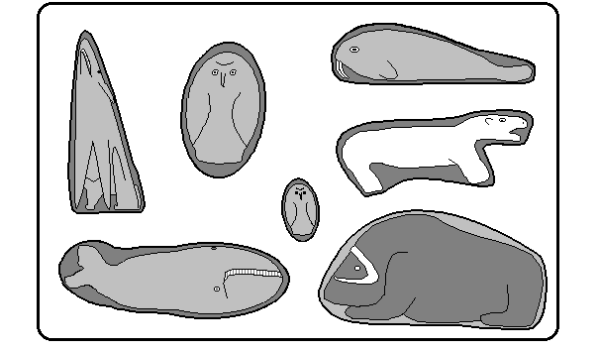
Hugh Livingstone was a sort of hermit who devoted most of his fifty-some years to the ancient craft of stone sculpture, which had been passed down for many generations in his family. The people of his village all revered the fantastic figures that he carved from what appeared to be rather ordinary stones. His process was always the same: he would take his time examining the stone, focusing very intensely on it, yet keeping his mind open and receptive, until the image that was locked inside the stone revealed itself to him. Then he would take his hammer and chisel, which he claimed were magical but which in fact appeared quite ordinary, to hew a few precise cuts into the stone, and the animal form emerged from the rock. A whole array of walruses, seals, polar bears, whales, yaks, marmots, eagles, ravens, and caribou came forth from the stones. Some of the forms were quite exotic to the Alaska tundra – tigers, boars, pythons, gazelles, kangaroos, and jackrabbits. The villagers were amazed by the extraordinary figures – they sometimes wondered how these strange stones found their way to Alaska from such faraway shores.

Hugh’s life was in harmony with his world, as were the lives of the other villagers – in harmony, that is, until the past few years, when the “ghost people” invaded the region to extract the natural resources from the land. The invaders from the lower 48 states found the name “ghost people” rather quaint, assuming that it referred simply to their lighter complexion. The villagers, however, based their perception of ghostliness not so much on skin color as on the unworldly mannerisms of the visitors: blank facial expressions, mechanical gestures and movements, and restricted vocal inflections. The villagers also noted that their landscape now appeared rather bleached out and deadened. Though disturbed by these changes, the villagers offered limited resistance, for they were comforted by the material prosperity and security which the invaders provided in exchange for the resources which they took from the land. The invasion apparently had a dramatic impact on Hugh’s art: many of his figures now were terrible and monstrous – dragons, gargoyles, dinosaurs, and gremlins – yet they all possessed the eerie beauty that marked his craft.

The invaders generally had little to do with the Eskimo culture: rather, they brought their own culture with them through VCR’s and satellite dishes, as well as the newly established taverns and chapels. Hugh’s craft offered the primary exception to this trend: many visitors found his figurines rather stylish or amusing, and they offered considerable money to possess them. A few of the ghost people actually became enchanted with the sculptures, some even noting that his stone figures were so life-like that they actually appeared to breathe. Hugh was initially perplexed by their response: their amusement and desire for possession were quite different from the awe and reverence his villagers bestowed upon his work. He was not used to the adulation doted upon him by the invaders, and he was quite taken in by it. His reputation quickly spread, such that scores of tourists went way out of their way to admire and buy his works. Others bought his pieces from a mail-order operation without even having seen them. He attained a celebrity status in his region of Alaska and became very proud of his fame and accomplishments.

Eventually Hugh was invited to present his works at a very prestigious art show in the lower forty-eight, without even having to apply for entry. The organizers even paid his expenses to attend. He was quite excited about making the long trip south, for he had never left his native village any farther than what his two feet could carry him in a week’s time. When the departure time approached and Hugh was busily packing, he discovered that he had few pieces remaining – he had sold practically all of his sculptures to the acquisitive tourists. It was too late to back out of the show, for he had committed himself to his village and his patrons, and he certainly did not want to disappoint them.

For the three remaining days and nights he worked constantly to produce an adequate stock for the art show. He no longer took the great care to discover the unique forms locked inside the stones. He had his customers to please and his own image to uphold, and that was foremost on his mind. So instead he took some of the standard forms that seemed the favorites of his customers, and he shaped the rocks into them. His attempts were by and large dismal failures. Most of the rocks turned out grotesque and malformed, yet lacking in the eerie elegance of his earlier monsters. Many of the stones fractured or crumbled under the impatient blows of his tools. Though he came up with a sufficient quantity of figures, they were quite disappointing to his fans and patrons, and a target of mockery for the art critics. Few bought his works, and in his shame he became as still and lifeless as the stones that he carved.

An example of hasty work to satisfy others, rather than shaped from the heart
Hugh Livingstone entitled this piece “Rockfish.” He noted that it represented his work at his rock-bottom, when he was desperate to win others’ approval. While displeased with this work, he agreed to my sharing it so that others might benefit from a lesson he had learned the hard way.

His stupor was so intense that his patrons could not even get him on the plane back North to his home. For weeks he refused to move or talk, sitting perfectly still. Having no other obvious recourse, his patrons had him admitted to the nearby state hospital, where he was diagnosed as having Catatonic Schizophrenia, Rigid Type. In the customary order of the hospital, I was assigned to work with Hugh. (Being at the bottom of the pecking order, trainees are routinely assigned the least promising cases, with the usually unexpressed attitude that there is less chance of doing harm.) I was content with this state of affairs, for a mute patient offers fewer opportunities to mess up, and I was just getting my feet wet with some real work. After a couple of weeks of regular daily sessions Hugh began to talk, yet all the while maintaining his rigid posture. He disclosed that he had become possessed by a terrible monster that could destroy anything or anyone in its path, and that the only defense against it was to lock it up inside a rock – hence, the catatonic rigidity. He revealed that the powerful medication put the monster to sleep, so that he could now talk in a whisper, so as not to awaken it. Hugh was quite taken with my interest, curiosity and patience, such that he referred to me as his shaman.

While I felt that Hugh was putting an inordinate amount of trust and confidence in me (and thus exercising poor judgment and reality testing), this did not stop me from proudly exhibiting my success in grand rounds. This move proved to be my undoing, for I emerged from my anonymity and received all sorts of encouragement and guidance as to how I should proceed with this now workable patient. In particular, I was encouraged to use the cognitive behavioral approach I was studying in my graduate training to challenge the patently irrational to outright delusional beliefs that Hugh was espousing. I must confess that at this point I was charged with enthusiasm, for now I would be doing real therapy, rather than merely supportive therapy, which I experienced as little more than faking it. Hugh’s trust and confidence were soon dispelled, however, when I began challenging his belief in the sleeping monster as no more than an irrational delusion. At that point he became highly volatile and explosive, destroying the furniture in the room and yelling out, “Sham, sham, sham.” After this outburst subsided, Hugh explained that I had awakened the monster, who then went on his rampage. If anything, my intervention had merely validated his delusion. These events had not escaped the notice of the ward staff, the training program, or my colleagues, and I received considerable attention, ranging from criticism and ridicule to condescension and sympathy. (I’m not sure which hurt worse.) Just as I had risen with pride, so had I plunged into despair. At the time I took little consolation from Hugh’s empathy, with his observation of the parallel between his own humiliation at the art show and my shame over his response to my intervention. (I’m not sure whether the role reversal or the accuracy of his comment troubled me more.)

Well, as for Hugh, the authorities at the state hospital did not appreciate his abdication of personal responsibility for his destructive actions, and they resented providing treatment to a nonresident who was so uncooperative with the program. They quickly arranged for his transfer back to Alaska. Not much is known about Hugh from this point on, for he returned to his village rather than being transferred to another state hospital. He did send me back a brief note, indicating that he was being treated by the shaman in the region. The monster had not been exorcised, but it had been tamed, such that Hugh viewed him as a faithful companion and protector. He was again sculpting stones, including some rather large boulders, but he was adamantly refusing to sell any of the pieces, for he now viewed that as a violation of his sacred pact: it was unfair to release the animals from the stones if he were only going to sell them back into captivity. I was pleased that he was again productive, though disappointed that he was not producing income and that he continued to be delusional.

Years later I have a fuller appreciation of my encounter with Hugh Livingstone. I address the lessons I have learned with some reluctance, for fear of reducing the experiences to a cold, abstract moral. Those readers who share this concern are invited to stop here, and others are advised to proceed at the risk of diminishing any air of enchantment derived from the tale. Though I still do not take all of Hugh’s pronouncements at face value, I generally view them as possessing a certain truth – even the “delusional” beliefs he espouses concerning his demon and the spirits he releases from rocks. This outlook can certainly be viewed as an argument against ethnocentrism and for multicultural relativism, thus endorsing the politically correct values of academia. Yet my realization concerns neither politics nor philosophy nor sociology, but personal reality (or phenomenology, to use the technical term). We could argue that his demon was simply his own rage over humiliation which he had refused to acknowledge as his own, and which therefore appeared alien to him. Or we could make a point that the spirits that were released through his sculpture came not out of the rocks, but from his own fertile imagination, and only resonated with the largely dormant spirituality of the so-called “ghost people.” Yet whatever such a translation gains in rational logic, it loses in access to a rich and unique perspective on the world. I see little to be gained from translating such poetry into prose, or from a related debate over literal versus metaphorical truth. I suppose these issues have their place, but not here, not now.

The primary lesson that I have learned is quite personal in nature, concerning an internal struggle for integrity, one that pits the ego against the broader self. I might paraphrase the message as, “Don’t sell your soul to boost your ego.” I grant that Goethe dramatized this lesson much earlier, but it was Hugh Livingstone, not Faust, who started me on the very personal quest of discovering the spirit hidden within mundane daily experience, both for myself and for the people I work with.

Bob Daniel, Ph.D. is a retired clinical psychologist who has been practicing in Virginia Beach for over thirty years. There, he worked in private practice with adults with mental health and substance abuse issues. Dr. Daniel has long valued stories and myths as vehicles of personal transformation, as noted in his post, Coping with Reality Through Enchantment: The Healing Power of Myth. He has been accused of being an unabashed prevaricator, but he insists that his stories are 100% true, even if not factually accurate. Another of his “true tales” is The Man with a Monkey on his Back, which addresses being our own worst critics. Still other tall tales, such as The Man Who Lost His Key and The Monks’ Interesting, Not-So-Silent Retreat, he borrowed and embellished from older folk and spiritual traditions. Dr. Daniel further explores our ability to infuse reality with our imagination in Are You Afflicted with Pareidola? .  

COPING WITH REALITY THROUGH ENCHANTMENT: THE HEALING POWER OF MYTH

by BOB DANIEL, Ph.D.

Long before psychotherapy was invented, healers have been using stories to help their people cope with life’s adversities. More recently, storytellers such as Joseph Campbell, Robert Bly, and Clarissa Pinkola Estes have demonstrated the power of myth for attaining personal transformation. Fannie Flagg dramatized this process in Fried Green Tomatoes at the Whistle Stop Cafe. Here, the elderly Mrs. Threadgoode inspired Evelyn, a dowdy, submissive housewife, by recounting her family tale. Through this encounter, Evelyn was able to discover her own inner strength (Towanda!).

Many such tales have been recorded and preserved as folklore. Countless others, though, are simply passed down orally from generation to generation. Many of these secret treasures risk oblivion in our mass culture, much as medicinal herbs are threatened with extinction from industrial society’s denudation of the tropical rain forests. I wish to share a particular tale from the Daniel family which has proven quite helpful for coping with stress and avoiding the pitfalls of “codependency” in helping others with their problems. So here’s the story of “The Quicksand Beds of Caramba Flats,” as told to me by my Uncle Lester:

The Quicksand Beds of Caramba FlatsSinking in Quicksand

“For generations, since long before the Europeans invaded the New World, people have been drawn to the quicksand beds of Caramba Flats. Not that anyone actually wanted to get stuck there, mind you. For miles around, as far as the eye could see, there is only desert, with little life. But here there is water, with its promise of restoration and renewal. Thus, people have sought out these potholes of clear, cool water that pocket the sandy beds. The Native Americans were well aware of the hazards of the quicksand. Yet through their caution and reverence for nature, they could reliably retrieve the water without being sucked under.

“For the Europeans it was quite another matter. Steeped in generations of civilization, they had lost touch with the ways of nature. They had neither the wariness nor the respect that such natural phenomena warrant. After days on the arid plains, they would catch sight of the shimmering water, and it was no mirage. Then they would dash down the nearby dunes and plunge headlong toward the pools. Before they knew it they were chest-deep in quicksand. More often than not, they would panic. And the more they panicked, the quicker the slurry would suck them under. Often, for just long enough to drown before their limp corpses float back up to the surface. From such instances came the lore of quicksand as the great gobbler of life.

“Now, I include these grizzly details because they convey a tragic irony. Namely, we are lighter than this mixture of sand and water. As such, we naturally float in it. Only by struggling and thrashing about do people dig themselves in deeper. 

“With so many having lost their lives in these beds, authorities posted wardens to rescue the unsuspecting pioneers. While knowledgeable about quicksand, the first wardens had little understanding of rescue techniques. Legend has it that several early wardens had lost their lives, pulled under by the very victims they were trying to save. Tales provide graphic details of  desperate victims clutching at the wardens and climbed up their backs. Thus, they submerged the hapless wardens, drowning them. With no printing presses there at the time, it is now impossible to separate history from myth.

“Whether these tales are actually true, later wardens developed rescue techniques to avoid the desperate clutches of the victims. Rather than venturing into the slurry themselves, they heaved ropes out to the reckless pioneers. Then, they anchored the other end of the rope to a boulder or a stump. This measure allowed the victims to pull themselves out with their own strength.

“Now it would be imprudent to say that the settlers actually tamed Caramba Flats. After all, nothing natural can be truly tamed. Still, they developed a respect for those quicksand beds that allowed them to establish the nearby community of Caramba Flats, right out there in the middle of the arid wasteland.”

The Moral

Now, my Uncle Lester is not the sort who leaves it to your imagination to fill in the moral of a story. So at the end he’d pause and lean over to say, “Now, Bob, I want you to remember this story whenever you feel overwhelmed, up to your neck in muck, so to speak. Just lean back, take a deep breath, and say to yourself, ‘Relax, no reason to worry . It’s only quicksand. I can float in it, and someone will come along to throw me a rope – maybe sooner if I holler.'”

And then he’d cock his finger and add, “Now if you see one of your friends thrashing around in the muck, so to speak, don’t you go jumpin’ in after ’em. Just remember – all you gotta do is throw ’em a rope. They can pull themselves out.”

Tall tales can be true!

Bob Daniel, Ph.D. is a retired clinical psychologist who has been practicing in Virginia Beach for over thirty years. He has worked in private practice with adults with mental health and substance abuse issues. While he has been accused of being an unabashed prevaricator, Dr. Daniel insists that his stories are 100% true, even if not factually accurate. Other such true tales include THE ESKIMO WHO LOST HIS ART AND SOUL and THE MAN WITH A MONKEY ON HIS BACK: A STORY OF THE STRUGGLE WITH SELF-BLAME. Still other tales in the “Stories and Fables” category are elaborations of older folk tales.

Beyond Rationality and Into the Realm of Paradox

Cognitive behaviorism has generally been recognized as the current prevailing model being applied to life’s problems. It has achieved such dominance that many assume this perspective as the preferred approach for understanding human experience and behavior. Indeed, some are so deeply embedded in this worldview that they don’t even consider other possibilities. This website proposes an existential model that provides a more relevant perspective from which to address certain aspects of the human condition, particularly those related to the paradoxical aspects of life. In particular, it draws on the distinctions between objectivity and subjectivity and between problem and paradox.

The Rise of Objectivity in Western Culture

Ever since Descartes rested the proof of one’s existence on one’s ability to reason (i.e., “Cogito, ergo sum.”), Western culture has exhibited a bias toward the objective perspective. Indeed, reflective awareness, the ability to step back and reflect on our involvement with the world and the people around us, gives us the impression of a separate identity in a way that subjective immersion in the “here and now” does not present. In this way, the Western worldview has come to view objective experience as a true and accurate representation of the world out there, whereas it tends to view subjective experience as idiosyncratic perceptions, colored and perhaps distorted by the biases of the individual. Hence, we often speak of objective reality and subjective experience.

The Barren Landscape of Objectivity

While the rise of objectivity in Western culture has fostered unprecedented advances in science and technology over the past 500 years, Yet such progress has come at a high cost. In becoming increasingly embedded in civilization, we have fallen out of harmony with nature.– a modern version of expulsion from paradise for eating the fruit of the tree of knowledge. Perhaps this development is a recapitulation of the biblical creation story. While this may not represent an orthodox interpretation of the biblical creation story, you might say? If you’re looking for a conventional perspective, what are you doing at the Rogue Psychologist website?

The experience (or some would say illusion) of separateness fosters alienation. Our relationships with others have become more objectified, with a greater tendency to use one another, rather than relating to each other. This distinction was highlights by Martin Buber’s contrast between I-It and I-Thou relationships, respectively. In the reductionism that is an inherent aspect of the pursuit of objective or abstract knowledge, we have lost touch with our rich subjective experience. When we process our experiences, particularly in recalling the past and in anticipating the future, our mental activities often involve cognitions (i.e. thoughts and interpretations), more so than sensations. The pursuit of knowledge might be compared to searching for the bedrock of objective knowledge by scraping away the cover of dirt, including the very topsoil upon which terrestrial life depends. Is it any wonder that in this barren psychic landscape, alienated souls have forsaken a lifelong quest for meaning and settled for drug-induced trips whose durations are measured in hours, or even minutes? In their classic, “Is That All There Is?”, made famous by Peggy Lee, songwriters Jerry Leiber and Mike Stoller responded to the “feeling that something was missing” with the refrain, “If that’s all there is, my friends, then let’s keep dancing. Let’s break out the booze and have a ball, if that’s all there is.”

Psychology’s Pursuit of Objective Knowledge

Psychology has largely followed this reductionist path through its emphasis on the scientist-practitioner model, in an attempt to emulate the rigors of the natural sciences in order to attain cultural legitimacy. Controlled experiments are designed to demonstrate the cause-and-effect relationships between various abstract factors, yet case studies that retain the complexities of relations are often dismissed as mere anecdotal evidence. Thus, the exploration of the intricate complexities of the human condition has been largely relegated to the arts and humanities.

The goal of this website is not the overthrow of objectivity and rationality, but rather the elevation of subjectivity to a comparable status, side-by-side with objectivity, so that we can explore how the two modes complement one another, like yin and yang. I propose that the interplay of subjective and objective perspectives on reality can point to a transcendent reality. Indeed, I undertook such an exploration in my doctoral dissertation nearly 30 years ago, when I examined the interplay of subjective and objective experience in the development of healthy selfhood. I plan to utilize this website as a means of expanding this pursuit to developing a broader understanding of the human condition – granted, a rather ambitious, if not grandiose, endeavor. In this pursuit, I am proposing paradox as a key element of the human condition, and perhaps in the makeup of the universe (Did I mention grandiose?).

Solving Problems or Embracing Paradox

When we encounter problems, our natural inclination is to look for a solution, typically using logic and reason to analyze the situation. On a cultural level, Western civilization has made remarkable advances in science and technology in applying the scientific method and the philosophy of science known as logical empiricism. But what if the dilemma we face has no rational solution? Here, we enter the realm of paradox. I cite an excerpt from my doctoral dissertation:

“Despite (and perhaps because of) our scientific inventions and discoveries, humans confront paradoxes without adaptive solutions.  We are capable of projecting ourselves into the past or future, yet remain tethered to the present.  We contemplate the infinite, yet cannot escape our own mortality.  We are determined by our histories, yet choose our future.  We are our bodies, yet we have bodies.  These are all features of the human condition for which science provides no solutions.  . . . It is here, where science falls short, that art speaks and perhaps comforts.” (R. Daniel, 1986)

Many are reluctant to cross that threshold into the realm of paradox, not realizing that they already live in that realm on a daily basis. Some who seek definitive, authoritative solutions are put off when they discover that these chapters in the book of life do not have definitive answers in the back of the book. Others have felt muddled and confused when presented with paradoxical phenomena from advanced disciplines. Koans (e.g., “What is the sound of one hand clapping?”) are familiar paradoxes in the Zen Buddhist tradition. In the field of physics, the Heisenberg uncertainty principle and the observation that light acts like both a particle and a wave are two frequently cited paradoxes. While such examples demonstrate the depth and breadth of paradox in the fabric of reality as we know it, they have little apparent relevance for daily life.

Paradoxes of Nature, Paradoxes of Daily Life

While I am intrigued by such examples, particularly when they point to a confluence of science and spirituality (cf. The Tao of Physics by Fritjof Capra and The Quantum and the Lotus by Matthieu Ricard and Trinh Xuan Thuan), I prefer to focus on paradox as it manifests itself in daily life. One of the more familiar of these paradoxes is that “you can’t have your cake and eat it, too.” While this saying can be taken quite literally, it also points to the choice between living in the moment and building for the future, or between being and becoming. Various other paradoxes permeate the human experience of daily life, as will be explored on this site. Rather than sharing vignettes from my clinical practice to illustrate such paradoxes, I prefer to cite literary examples, such as those hidden in plain sight in the comic strips of the daily newspaper. These speak to the universality of such experiences, whereas clinical case studies might be construed as deviant, if not pathological, variations of the human condition. When possible, I will provide links to the particular comic strips that illustrate the inherent paradoxes of daily life. I trust that the authors will see these citations as attempts to illuminate the profound insights in works that are often passed over as amusing diversions.

Coming Attractions

Initially, I will be submitting articles and presentations that I have authored over the past 20 years or so. One of my early submissions was taken from my PowerPoint presentation, entitled “Living Rationally in a Paradoxical Universe: Maintaining Sanity in a Crazy World, Or Trying to Fit a Square Peg into a Round Hole?” I will follow this up with other PowerPoint presentations, some of my self-help articles, and my stories and parables. I will also commit some more of my current thinking to print, with this hopefully being an ever-evolving process. I also plan to share some of my own personal experiences that have helped to shape my worldview. I eventually plan to translate my doctoral dissertation into a more vernacular language and style. My perspective has involved over time, so I will likely do some revising and updating of these works. Yet I may also leave some of these works much as I first wrote them, inviting input from blogs, perhaps to make this website more of a living document and less of a static production. I plan to pose questions to stimulate further thought among my readership, rather than suggesting that I have the definitive last word. I invite readers to share similar themes and patterns from their own perspectives, as I expect there to be a certain resonance among various traditions. Hopefully, such a process can use multiple perspectives to develop a sort of depth perception. I only ask that you respect the integrity of the outlook presented on this website, rather than attempting to subsume this orientation under your own favorite theory or model.  I am seeking to establish a dialectical process in order to develop greater understanding and meaning in life. This includes the Hegelian sense of dialectics, in which a new synthesis evolves from the interaction of thesis and antithesis. Note that I am using cognitive behaviorism as the conventional wisdom or thesis to which paradoxical existentialism provides a counterpoint or antithesis. (Hence, my claim to my role as a rogue psychologist.) It would be ingenuous for me to take this stance, unless I were willing to allow the same freedom of “loyal opposition” among my readers. Feedback from others can be helpful for uncovering implicit assumptions in my perspective, which I welcome (I think!). I just ask that you strive to keep your feedback constructive and that you keep open to considering your own particular assumptions and biases.  I might suggest that you take a “Jeopardy” approach, in making your observation in the form of a question, which frequently does more to illuminate issues than does criticism, constructive or otherwise.

Playing with Paradox

Much of this exploration will be undertaken in a playful manner, as I find much of academic psychology to be rather dry and boring. (I will provide references for the various ideas expressed in this website, for those who want to pursue such lines of thinking anymore serious manner.)  The exploration of paradox would be lacking without the use of humor – indeed, paradox is perhaps the prime ingredient for humor. Whereas reason and logic can be useful tools, they do not provide much guidance when we are looking at issues of meaning and purpose. I address this issue in a PowerPoint presentation, entitled, “Living Rationally in a Paradoxical Universe: Maintaining Sanity in a Crazy World, Or Trying to Fit a Square Peg into a Round Hole?” This provides much of the basic framework for my explorations of the paradoxical universe on this website. This will also lead into another favorite theme of mine, which I first addressed in a self-help article about 20 years ago, entitled “Vicious Cycle Patterns in Relationships: Tips on How To Stop Spinning Your Wheels.” I will also post several of my therapeutic stories, including “The Man with a Monkey on His Back,” about being our own worst critic, “The Eskimo Who Lost His Art and Soul,” on the importance of being true to ourselves rather than selling out, and my Uncle Lester’s story of “The Quicksand Beds of Carumba Flats,” with implications on how to deal with stress, whether our own or that of others. I value storytelling for imparting wisdom, and I paraphrase a Sufi saying, to the effect that “If you want to change a person’s mind, you give a lecture or a discourse, but if you want to touch a person’s heart, you tell a story.”

IMG_0279

I had intended to initiate my website on my birthdate of July 20, or Il Venti Luglio in Italian, otherwise known as “Lunatic’s Feast Day,” but was not able to get everything together so quickly, as there was a gestation process with which to contend. I will still mark this day as the inception for this endeavor, as I find its spirit resonating with the following myth set in the Middle Ages:

Have you ever wondered how craziness has gotten associated with the moon?  We will probably never know for sure, as both lunacy and lunar have their common root in the same Latin word.  One compelling candidate for the association has been carried on in the Tuscan feast of Il Venti Lugio (The 20th of July), otherwise known as the Lunatic’s Feast Day.  This is an obscure Italian festival with its origins in the Tuscan hill towns during the Middle Ages.  When the peasants observed a lunar eclipse during a severe drought and heat wave, mass hysteria broke out.  They interpreted the copperish color of the partial eclipse of the moon, distorted by the shimmering heat waves of the evening air, as the moon catching on fire.  Then, during the total eclipse phase, they assumed that it had become consumed.  Many interpreted this development as a sign that the Apocalypse was near at hand.  Relieved when the moon reappeared intact a couple of hours later, a spontaneous celebration broke out for the rest of the night.  The next day a cool, soaking rain began that lasted for two whole weeks, thus breaking the drought.  This served as the basis of the Church feast of Il Venti Lugio each July 20th, in which lunacy was celebrated as a prelude to regeneration and renewal.  By the 17th Century the celebration had taken on a raucous pagan character, resulting in the Church officials denouncing the event and persecuting its participants during what later became known as the Tuscan Inquisition.  Even though eight women were tried and drowned as sorceresses, secret societies maintained the tradition into the 20th century.  Then, on this date in 1969, Neal Armstrong took “one small step for man, one giant leap for mankind,” with the first ever moonwalk.  This heralded the revival of the festival, which now celebrates the mysterious synchronicities in nature and human experience.

Some have questioned the veracity of this account, but then, there are always those who contend that the lunar landing was an elaborate hoax. Besides, I recall Hugh Livingstone, the Eskimo sculptor in my story, The Eskimo Who Lost his Art and Soul,  telling me, “Don’t confuse truth with fact.” And if anyone you tell about this feast day questions its authenticity, you can tell them that you know it’s true because you saw it on the internet.