Baring Your Soul, Bearing Your Stress

Social support is often crucial for bearing our stress, yet baring our souls is necessary for that to happen. Unless we open up, others cannot hear our pain and provide the needed comforting, encouragement, and understanding. This post explores how the Serenity Prayer offers guidance for choosing among these three listening approaches:

The saying suggests strategies for handling different types of stressors.primary guideline of this article for handling stressors
The Serenity Player offers guidelines for addressing different types of stressors.

A Personal Approach to Pain and Stress

Few people relish the idea of embracing emotional pain. If we can avoid dealing with it, we often do. With repeated avoidance, our residual feelings – anger, sadness, resentment, shame, etc. – accumulate over time. As the various feelings get lumped together, they lose their definition.  We forget the events that evoked them, as well as their meaning for us. Thus, we experience tension or discomfort,  yet without a readily identifiable source or an obvious remedy.

Defining our Terms

Often, we have difficulty describing, or even naming, this vague condition. Here, we can borrow from health science the general term, “stress.” We can further specify “emotional stress” as the accumulated feelings which were not sufficiently processed and resolved. (I have at times referred to this as my trash compactor model of stress.) Additionally, we can define “stressors” as the particular events that triggered the feelings that make up the emotional stress.

General Stress Reduction

We have various outlets to relieve stress, in the areas of exercise, recreation, and relaxation. These approaches, though, are quite general. They do not address the specific stressors and feelings that contributed to the overall stress. And just where does that relief get you, if you continue accumulating stress? When similar situations occur (and they will!), these events will only evoke more distressing feelings. This may lead to a “revolving door,” where we encounter the same challenges, day after day.

A More Targeted Approach

Thus,  we need to supplement our stress reduction efforts with a focus on the stressors behind the stress. This would involve recognizing the various feelings contributing to the accumulated stress. Then, we can identify the stressors triggering those feelings. At this point, the Serenity Prayer can help us sort out what we can change and what we must accept. Thus, an effective long-term approach to stress would include sorting out the various emotional components of the accumulated stress, identifying the stressors that trigger each of them, and working toward resolving them one at a time.

 Developing Stress Tolerance

An approach to stress that addresses the various stressors at their source recommends not only strategies to reduce tension, but also methods for enhancing our stress tolerance. While tension-reduction techniques are certainly helpful for coping with stress, the active exploration of the stressors requires a willingness and a capacity to tolerate the related emotional pain. This is particularly true when we encounter complicated situations which require time to resolve: we must be able to bear the tension to see this process through.

Stress in Modern Times

Our modern society complicates this process further: our greater range of options carries a price of increased complexity and ambiguity. (This feature is explored in greater detail in my post, Muddling down a Middle Path: Wading through the Messiness of Life.) Interpersonal conflict complicates the matter further, as our differing values lead us to view various situations and issues differently. This complicates our task of negotiating, collaborating, and compromising to achieve mutually agreeable solutions. Thus, in a society such as ours that values individuality as well as community, we experience a greater pressure on our ability to tolerate stress.

On the Origins of Stress Tolerance

How do we increase our ability to endure emotional pain? To answer this question, it is helpful to consider how we developed this capacity in the first place. While some aspects are no doubt innate, we initially depended upon the tending and comforting of our caretakers to ease our distress. Without the ability to fend for ourselves, we required our parents to read our distress signals and to tend to our needs. Later, they helped us to label our various need states (e.g., hunger, thirst, fatigue, etc.), so that we could ask for what we want and need. While they tended to our needs and protected us from the objects of our fears, their calming and comforting presence soothed not only physical pain and discomfort, but also emotional distress.

As we grew older, our parents, teachers, coaches and mentors aided our independence by teaching us how to take care of our own needs, rather than our depending so much on others to meet them. They guided us in our efforts and encouraged us to take risks according to our abilities, building our confidence and countering our fears, distress, and anxiety. As we matured, we internalized these functions of comforting, understanding, and guidance, so that we could provide these functions for ourselves when our caretakers were unavailable.

The Legacy of “Dysfunctional Families”

Unfortunately, not all the concern from our caretakers helped us to tolerate stress. This is particularly true if we came from so-called “dysfunctional families.” In fact, the attention may have cultivated stress intolerance. For example, our caretakers may have been uncomfortable dealing with the pain, regardless of their actual verbal response. In this case, their obvious distress may have amplified our pain. Or our helpers may have avoided acknowledging the suffering by reassuring us that “everything will be all right.” If so, we may have felt all the more alone, feeling that no one really understood us. Or they may have admonished us to be strong, not weak. This may have encouraged us to suppress our pain, sending it underground, to be dealt with alone.

Coping with the Unavailable Caretaker

This resolution runs the risk that the pain later gets acted out in anger towards others, rather than being discussed with others or processed internally before being expressed appropriately. The rage reaction is all the more likely if our caretakers reacted with anger, either to their own frustrations or to ours. Unfortunately, we tend to learn these bad habits as well as the good ones. Such experiences leave us mistrustful and reluctant to express ourselves to others later in life, making the needed emotional support all the more unlikely. Not only does this limit our external support, it also thwarts our internalizing the functions of comforting, understanding, and encouragement, which are needed to develop our own capacity to bear pain and tolerate stress.

Letting Ourselves Receive Support

Even if our caretakers didn’t foster our capacity to endure pain, it’s never too late to work on it. As in our youth, this process works best with the caring support of others. Granted, the act of “pulling ourselves up by our bootstraps” may appeal to our pride. Still, this approach likely fosters a stoic manner, with its often undeveloped spontaneity, vitality, and compassion. It may indeed be rather humbling to depend upon others for emotional support when we figure we ought to be able to handle the situations for ourselves. On the other hand, such humility may grant us better appreciation of our common humanity through sharing our pain and suffering with one another.

Besides, such self-reliance may not be all that independent. It might just represent compliance with earlier messages from critical parents (e.g., “Be a man.”). The irony is that such pride in independence may have its roots in unquestioning conformity to parental authority.

 Getting the Support We Need

Just how can others help us with bearing our pain? What makes their attention effective at comforting our distress? Here, there is no single answer, yet the Serenity Prayer can help us to understand the various components of a supportive approach. The prayer asks for “the serenity to accept the things [we] cannot change, the courage to change those things [we] can, and the wisdom to know the difference.” For each of these three personal qualities there is a complementary role of the listener who witnesses our pain: for serenity, soothing and comforting; for courage, guidance and encouragement; and for wisdom, understanding.

The Soothing Role in Attaining Serenity

Serenity, the first of these functions, involves a soothing and comforting that allows us to tolerate our pain. In contrast, distress or worry about the pain that we face amplifies our experience of the pain. Often, it is not the pain itself that is unbearable. Rather, it is our distress over dealing with or avoiding the pain that feels intolerable. A sense of dread or apprehension about the outcome of the painful episode is one possible aspect of this distress. Another is the sense that the events that evoked the feelings are unjust,  violating some implicit rules we live by. Yet another is a sense of shame for our involvement in the events surrounding the pain. Here, we assume much of the blame and guilt for the happenings. This low self-worth may lead us to isolate ourselves from others whom we assume will judge us harshly.

Developing Acceptance

Here the supportive presence of others can do much to ease our distress and low self-worth. Their acceptance of us despite our shortcomings can bolster our self-worth that has been challenged by our stressors. They can give us a sense of their continuing support and caring regardless of how the surrounding events unfold. Our supporters can help us accept the current circumstances as a challenge to grow, despite the unfairness of the situation. Or they can guide us toward coping with what is, rather than complaining helplessly about how it should be. Our supporters convey their messages not only through the meaning of their words, but also by their style of delivery. A soothing voice, a gentle embrace, or an accepting gaze goes beyond words in conveying their caring.

Tolerating Loss and Adversity

While these supportive functions do not resolve the stressful situation, they reduce the associated distress that often makes the pain unbearable. When the events surrounding the pain are irreversible, as in the case of death, or unresolvable, as with a divorce from an intractable marriage, the tolerance for the pain allows the grieving to proceed and the healing to begin. In other instances, in which there is some potential for problem-solving or conflict resolution, the tolerance for the pain allows us to face our dilemma and plan how we are to deal with it. In either case, the comforting function is often an essential step in allowing ourselves to face the pain so that we can understand it.

The Understanding Role in Fostering  Wisdom

By understanding pain, we discover its meaning. Meaningful pain is generally more bearable than meaningless pain. We give it a name, we define it, and in the process we limited its scope. Thus, understanding is a second important function in developing our capacity to bear pain.

Pain as a Warning Signal

Through this process we come to view pain not as a feeling state to avoid. Rather, stress  serves as a signal that all is not right in our world. It calls out that something needs adjustment. That change might be internal (e.g., grieving a loss or adjusting our expectations). Or it may be external (e.g., confronting a task or addressing a conflict with another). With such an outlook, we face our emotional hurts, determine the events which caused them, explore our perception of these events and our expectations surrounding them, identify our characteristic style of response to them, and to decide whether that approach is the most helpful. This process is one of redefinition and discovery of ourselves as well as of our personal worlds, whether the changes be related to some loss or gain or a reorganization of our lives.

Getting Support for Self-discovery

This self-discovery can at times be an exciting process, yet often is a humbling one. Either way, it is quite difficult to conduct by oneself, as we have difficulty stepping outside of ourselves to get an overall perspective on a situation that includes us in it. Others can help this process along by sharing their perception of us, revealing to us what is hidden by our own blind spots, what is out of focus, and what is distorted, whether positively or negatively. They can help us to discover how our response styles impact others and affect the problems we face. We can then decide whether that effect is likely helpful or harmful.

When Understanding Reinforces Acceptance

The understanding function does much to amplify the supportive function. By seeing the overall perspective we may not be quite so harsh in blaming ourselves. With a clear view of what is, our distress may not be as aggravated by our sense of what should be. We may better appreciate our values and principles as useful guides for living, rather than as universal laws upon which we can stake our security and well-being. We may view the problem more positively, as a potential growth experience, not an obstacle that blocks our path.

Cultivating Emotional Wisdom

Understanding helps us develop insight into ourselves and our world, yet without compassion it remains an intellectual exercise. We can experience our world and ourselves in subtle complexities. Multiple perspectives gives our world depth. We can see not just in black and white, but in various shades of gray.

Coloring our World

But what about color? This is where feelings have a second function: besides the role of signaling a disruption in our lives, they also enrich our experience. In an earlier article, I use the analogy of a prism to describe the process of sorting out the various emotional components of stress: that this exploration separates out the “white light” of stress into the various emotional hues. In fact, our idioms for our emotions have often assigned colors to various feelings – the red heat of passion, the yellow of cowardice, the blues of sadness, being “green with envy.” This process helps us to recover a more colorful picture of ourselves than presented with the general description of being tensed up or stressed out. This colorization of our experience with feelings enriches our lives and complements the definition and articulation provided by our intellectual understanding and insight.

From Physical Feelings to Emotional Feelings

Yet it is primarily through body sensations that our experiences attain their distinctive emotional tones. In connecting our various tactile, visceral, and kinesthetic responses to the events, interactions, expectations, and relationships that arouse them, we convert physical feelings into emotional feelings. Having your “hair stand on end” in fear, being “sick to your stomach” in disgust, and “getting all choked up” in sadness are more than mere figures of speech: they refer to emotions deeply felt in our bodies. A variation of the parental “tell me where it hurts” can help us to recognize the emotional components in our reactions to stressors. Thus, understanding from others helps us to associate our feelings states with the events and relationships in our lives in a way that colors and embodies our experience, making our lives richer and more meaningful in the process.

 The Encouragement Roles in Fostering Courage

The functions of compassion and understanding outlined above help us to adjust to our world. We do so by accepting the limits of our influence in this vast world we encounter. Yet we not only respond to our environment, we exert influence over it. Understanding not only deepens our appreciation of our world, it helps us act on our surroundings. We can get what we need from it, and reduce or eliminate threats from it. Insight does not produce such changes per se: it must be put into action to effect change.

Managing Risk

Yet such actions come with a risk: if they did not, then the warning signals of our emotional reactions probably would not have gone off. Usually there is some conflict involved – we balk at pursuing our desires because of some real or potential cost. Understanding can help to put these risks in perspective, but they do not eliminate them. Insight may suggest to us what we need to do to improve our lives, but we still need courage to make these changes, and the encouragement of others can be helpful here. Others are helpful when they stick by us, continuing to urge us on when we balk, retreat, or simply get stuck. The motivational function primarily encourages us to take the necessary, often risky and unpleasant steps required to resolve a conflict or problem causing us stress.

 Balancing the Three Supportive Functions

The Serenity Prayer suggests the importance of finding a balance among the three supportive functions of soothing, encouragement, and understanding. An excess in any one element can be harmful to overall functioning. An overly soothing approach without understanding the issues or encouraging action can foster helplessness and dependency. This is particularly problematic in facing (or avoiding) situations for which action is required. An emphasis on understanding without adequate soothing may foster an intellectualized approach similar to Mr. Spock’s demeanor on Star Trek. An accompanying lack of encouragement may lead to an intellectual immobilization involving worry and rumination, similar to that dramatized by Shakespeare’s Hamlet.

A encouraging role may lead to action which lacks an appreciation for the subtleties of feelings, whether one’s own or those of others. It further is less appropriate in those situations of loss for which there is no adequate remedy except acceptance. These various examples of imbalances of support should show the need for a balanced approach that fosters thought, feeling, and action in response to emotionally tinged situations.

Of course, the particular demands of a situation will recommend emphasis of one approach over another. Some call for valor, others for compassion and sensitivity, and still others for restraint and deliberation. Another factor concerns the personal style of the person needing support. Here, it is often helpful to “play to the person’s weak suit.” This approach encourages balance by supporting the function that is typically underutilized.

Internalizing the Three Supportive Functions

Of course, we can’t always count on others to be by our sides as we deal with  our stress. Nor should we expect that. Throughout our lives, we developed our own abilities to resolve our stresses. Much of this we accomplished by internalizing the supportive functions provided by others. First, we learned to comfort ourselves by conjuring up the supportive demeanor of our caretakers in their absence. Second, we gained perspective on situations by asking ourselves how our mentors would have viewed them.  And third, we mustered our courage and took risks by imagining the urging of our coaches. We can now conjure up these presences consciously and deliberately. And even if we don’t, they still remain a potent voice in the background as we face our challenges.

When Doing Less Is Doing More

Others can help us to internalize these functions by not doing too much for us. Sometimes doing less is actually doing more. Our supporters may ask us how we can comfort ourselves in the meantime rather than coming over at 2 a.m. They may simply provide a sounding board to bounce off our own ideas, rather than defining the situations for us. They may ask us to consider our options, rather than giving us direct advice. Often we simply need someone to bear witness as we bare our souls in order to bear our pain.

Finding Balance in Interdependence

By internalizing the supportive functions of comforting, understanding, and encouraging, we cultivate our serenity, wisdom, and courage. We can better cope with our various emotional challenges with greater self-reliance and confidence. Still, it is not necessary, or even preferable, that we become totally self-sufficient. Rather than pursuing the ideal of independence, perhaps interdependence is a better goal, involving mutual support with others. We can still rely on others who may be farther along. And through their limited support, we can further develop our own capacity to bear our pain and stress. And in turn, we may serve as mentors, comforters, coaches, teachers, and parental figures for others.

The Intimacy of Reciprocal Support

Yet it is when the support is reciprocal that the special treasure of emotional intimacy unfolds. We then expose our private fears, doubts, and feelings to the caring of others, and care for theirs in return. This reciprocity offers depth, meaning, and strength to our lives in a way that total independence cannot achieve. On the broader scale, this mutuality of support fosters a sense of family, fellowship, and community. The balance between self-care and mutual interdependence with others promotes a healthy balance between individuality and belonging. This strengthens both our personal identities and our ties to others.

Escaping the Victim Role

The current post identifies features of the Victim role and explores strategies for escaping this role. This draws upon the vicious cycle patterns addressed in a previous post, including Steven Karpman’s Persecutor – Victim – Rescuer cycle, cited in Games Alcoholics Play, by Claude Steiner. Most people are probably familiar enough with the Victim role so that it needs no introduction. If you haven’t fallen into that role yourself, you no doubt have encountered others who have. Or perhaps you have been cast in the complementary role of either the Oppressor or the Enabler in dealing with the Victim role. Of course, your familiarity with the subject won’t stop me from sharing my ideas about it.

Defining the Victim Role

The Victim role represents a particular response to suffering. This might be described through the questions, “Why is this happening to me, of all people?” and “What did I ever do to deserve this?” Implied in such questions is an assumption that life should be fair, and that we should get our just desserts without having to struggle for them. This sentiment is so common that Rabbi Harold Kushner wrote an entire book, Why Bad Things Happen to Good People, to address it.

The Victim Role in Relation to the Oppressor Role

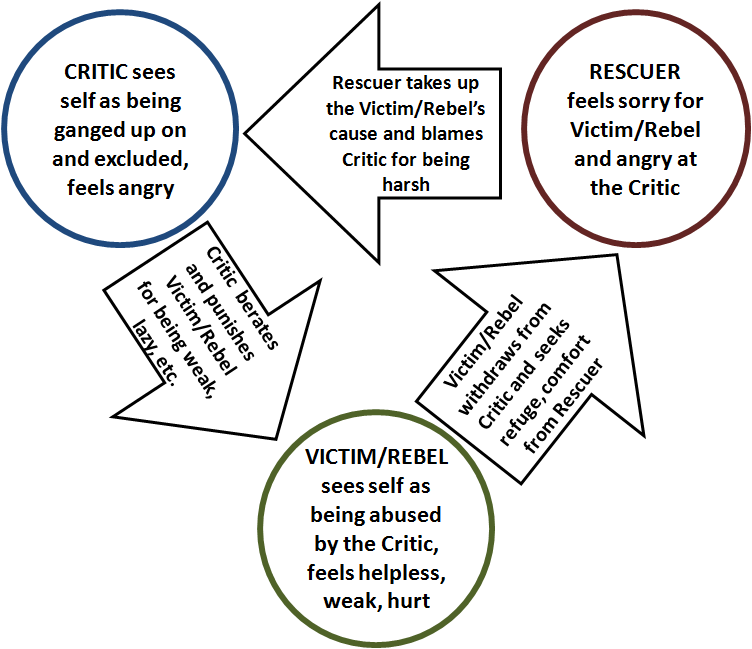
While the Victim role is sometimes adopted in reaction to events such as illness, accidents, and natural disasters, more often it is a response to the actions of others who are seen as intentionally abusive or unjust. This frequently involves establishing relatively enduring interaction patterns between the Victim and the Oppressor, as discussed in my page, Vicious Cycle Patterns in Relationships 2.0. Below is a diagram illustrating a common interplay between the Victim and the Critic, a relatively benign variation on the Oppressor role.critic-victim-cycle1

Here, Victims view their Oppressors as powerful and controlling, and in turn see themselves as powerless, helpless, and hopeless. These perceptions often serve as self-fulfilling prophecies, as they encourage Victims to practice avoidant and accommodating styles of dealing with conflict in relationships. In the process, other styles for dealing with conflict get neglected, resulting in a deficit of assertiveness and conflict-resolution skills: if you don’t use it, you lose it. In turn, the lack of such skills makes one all the more vulnerable to oppression by others.

Self-empowerment as an Escape Plan

The above description of the Victim role suggests self-empowerment as a means for escaping the role. This typically involves a willingness to engage in conflict rather than avoiding it or capitulating to the demands of others. Commitment to this approach is only a start – empowerment requires working smarter, not just harder. Not only can we work toward mastering the different interpersonal conflict strategies, addressed in a previous post, but we can also develop our understanding of when each is appropriate. Just as in football, where each side runs different plays depending on the game’s circumstances and the anticipated play of the opponent, strategy counts in conflict resolution. Perseverance counts, too: note that wars have been won even when the majority of the battles have gone to the other side. It is prudent to choose our battles, and to retreat in order to fight another day.

Knowledge is Power

Holding our own in conflicts may well depend upon our understanding not only of our adversaries, but also of ourselves. By understanding our adversaries, their weaknesses as well as their strengths, we can better judge when and where to use leverage effectively, and when and how to propose compromises from a position of strength. Stephen Mitchell’s translation of the Tao Te Ching notes the risk of underestimating one’s adversaries, such as by viewing them as evil. Such a simplistic perspective may blind us to the complexity of their perspectives and motivations, thus placing us at a disadvantage. Perhaps an even more difficult challenge is understanding ourselves: the Gospels note Jesus observing how it is easier to spot the splinter in another’s eye than to see the beam in our own. It is also quite helpful to understand how our interpersonal styles interact with the styles with others. My webpage, Vicious Cycle Patterns in Relationships 2.0, explores how certain common roles tend to interact with one other in a vicious cycle pattern. It offers some general suggestions for escaping the vicious cycle roles, regardless of the particular role one has assumed.

Shifting the Balance of Fight vs. Flight

Once one understands various aspects of a conflict, one can then put this understanding into practice through active engagement with one’s adversary. Here the motivational factor is quite relevant, with anger and fear being basic emotions involved. Anger charges us up to confront our adversaries, while fear serves to mobilize us to flee to escape danger. In evolutionary terms, our biological system is wired for a Fight vs. Flight reaction, which is appropriate for survival in life-or-death situations, but is excessive for most conflicts in civilized society. As we become more knowledgeable and skillful in dealing with interpersonal conflict, we become better able to stand our ground and assert our claims. Here, intense fear and anxiety can get in the way of this process by supporting old patterns of avoidance and submission. Anger can serve to override our fears and mobilize our active engagement in conflict, yet its intensity can be disruptive to the processes of negotiation and conflict resolution. Like steel, anger must be tempered to be used effectively. One strategy to accomplish this involves the use of meditation or other relaxation techniques to reduce the intensity of emotions from “so mad you can’t see straight” to a more moderate level.

Challenging the Attitudes That Incite Impotent Rage

In confronting our anger, we should recognize that our anger can be incited to rage not only through our more primitive Fight vs. Flight reaction, but also through our more advanced thought processes. This issue is addressed in a previous post, When Thinking Distorts Feelings. The post also presents a strategy for challenging some of the attitudes and underlying assumptions that fuel the fire of emotions, often to the point of their being disruptive rather than helpful (hence the term, “impotent rage”). By putting our anger and anxiety into proper perspective, we are better able to assert ourselves, rather than either going ballistic with rage or capitulating to our adversaries out of fear.

Developing a Positive and Realistic Perspective

There are other attitudes and expectations that often discourage us from asserting ourselves effectively in conflict. For one thing, it is pretty common to get discouraged when we stumble in our efforts to assert ourselves. We may need to remind ourselves that we can expect to make mistakes as we are practicing our newly learned assertion skills. We can reassure ourselves that these are only failures if we give up on the process. Furthermore, it helps to recognize that we can learn more from our mistakes than we can from our successes, unless we are blaming ourselves too harshly. It is also reassuring to know that progress is seldom linear, with it often involving two or three steps forward, followed by one or two steps back. We may also need to give ourselves permission to choose our battles, so that we might “live to fight another day.” We can also console ourselves with the recognition that wars have been won even when most of the battles went to the other side. Strategic retreat can be a valuable tactic, as long as it does not turn into unconditional surrender. Unless we adopt these attitudes, we run the risk of falling into the Critic role with ourselves, thus becoming “our own worst critics.”

How Do You Spell Relief?

Dealing with conflict is often a stressful experience, and strategic retreats to gain temporary relief can be valuable for sustaining our efforts. Here it is important to distinguish healthy outlets from those that actually “recycle” stress by providing temporary relief while worsening the overall situation. The latter often involve activities such as abusing substances, gambling, compulsive shopping, pornography, and comfort eating. Even when these outlets are pursued for strategic retreat, their emotional numbing and distraction often result in unconditional surrender through subsequent avoidance of the conflict. Furthermore, these outlets often give the Critic more ammunition with which to judge and blame the Victim, thus placing the Victim at an even greater disadvantage. Healthier outlets are available, though, with these generally fall into the categories of relaxation, recreation, exercise, and expression.

The Victim Role in Relation to the Enabler Role

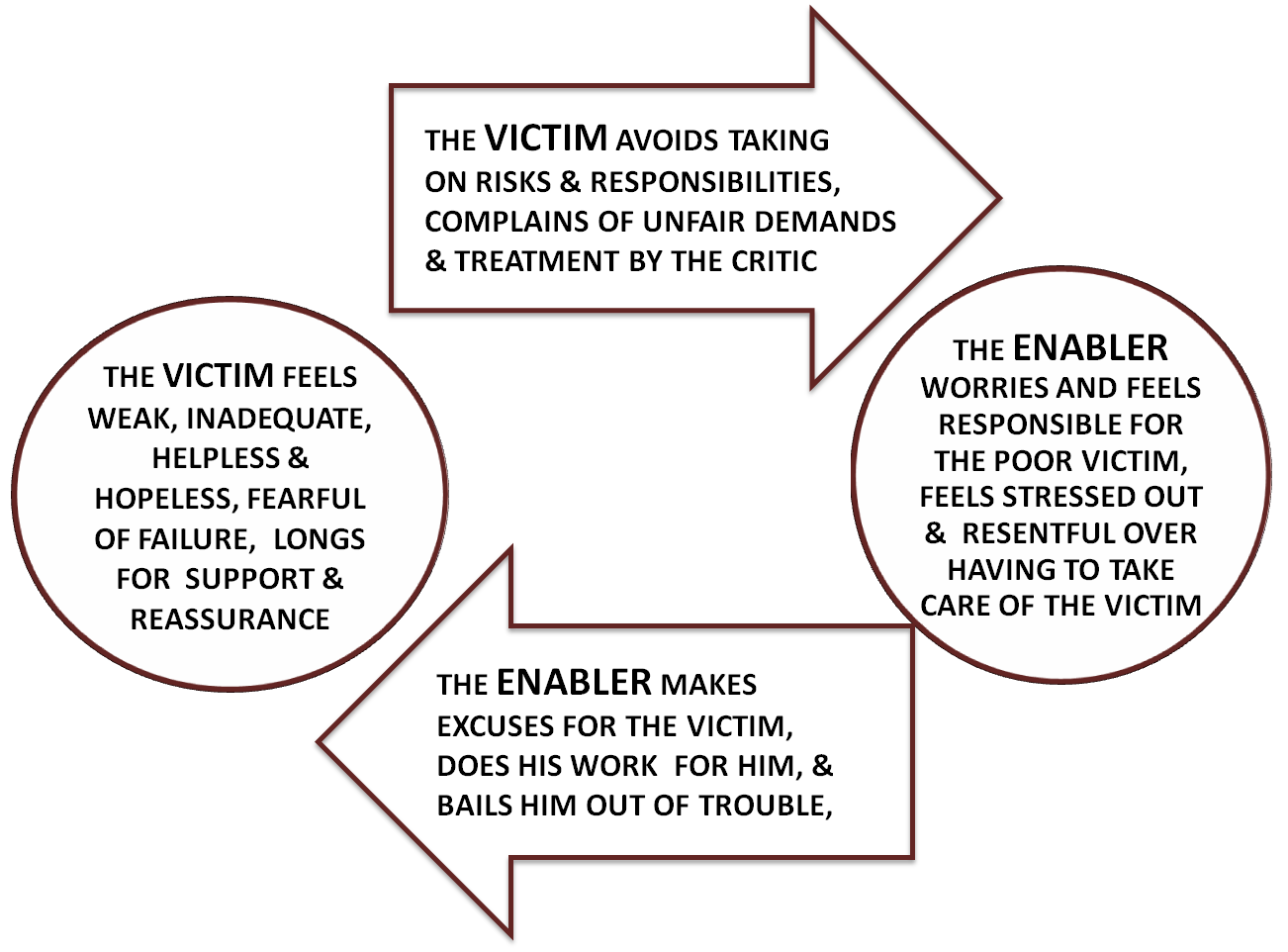
Thus far, the Victim role has been defined in relation to the Oppressor role and its variants, such as the Critic, the Persecutor, and the Abuser. The Victim role is also defined through its interaction with another interpersonal role, that of the Rescuer or the Enabler, with this pattern diagrammed below.victim-enabler-cycle

In this particular pattern, Victims express themselves through complaints about unfair conditions in their lives. They frequently seek out some tangible support or relief. This may not be explicitly stated, and often does not need to be, as Enablers are ready to volunteer support without even being asked for it. The sought-after relief may take many forms: provision of a safe haven, advocacy in defense of the Victims, mediation to resolve the conflict, protection from the wrath of Critics or Persecutors, concealment of mistakes, accidents, or wrongdoings, or completing the Victims’ responsibilities for them. While Enablers practice and develop their own assertion, advocacy, and communication skills in fulfilling these functions, Victims are relieved of this responsibility and thus fail to practice and develop these skills for themselves. This leaves them less competent and all the more dependent on the generous support of the Enablers, as well as more susceptible to the scorn of the Critics.

The Escape: “Please, I Need to Do This Myself”

It should be fairly obvious from the above discussion that one means of escaping the Victim role is to resist seeking support or relief from Rescuers, when we are capable of fulfilling these functions for ourselves. This also involves declining the unsolicited offers of those services, as well. That may require considerable self-discipline: why go through all that hassle when someone else will do it for us? This does not mean that we cannot accept someone’s support, as long as we retain responsibility for our position. Taking this approach provides the practice required to develop competence, earn credibility, and empower ourselves.

Complaints: Communication without Personal Vulnerability

In voicing their complaints to their Enablers, Victims often focus on external circumstances, rather than sharing their own personal experiences. In doing so, Victims claim the moral high ground in focusing on the abusive actions of the Critic, often without addressing their own shortcomings or the legitimacy of some of the Critic’s complaints. They often overlook their own passive-aggressive behavior, avoidance of conflict, and reluctance to challenge the Critic’s authority, all of which feed into the vicious cycle. By focusing on the faults of the Critics, Victims deflect attention from themselves, thus reducing the personal vulnerability involved in sharing their own anxieties, insecurities, and shame.

Beyond Complaining and into the Realm of Relating

We can escape the Victim mindset by sharing how we are feeling and doing, rather than just complaining about external events. This involves focusing on what is, rather than on what should or shouldn’t be. Being open about our fears and insecurities requires both humility and trust. Admitting our limitations may be humbling, but it helps to minimize the humiliation that comes with others recognizing our shortcomings before we acknowledge them. Opening up requires trust both in our confidantes and in ourselves: trust in the other to respect our feelings and honor our privacy, and trust in ourselves to cope effectively with those occasions when our confidantes lets us down in one way or another. While complaining about our situation may bring Enablers to our rescue, expressing our feelings is more likely to elicit compassion from our listeners. In the long run, being cared for is likely to be more beneficial than being taken care of. A further feature of open sharing is the experience of gratitude for the other’s compassionate presence. Not only can gratitude help us not to wallow in the role of Victim, but it can also encourage our confidantes to feel appreciated for their compassion. This, in turn, could help to discourage the confidantes from assuming an Enabler role that is detrimental to our growth. All of these developments help to shift the emphasis of the relationship from using the other for our own needs to that of relating to one another.

Emotional Intimacy Is a Two-way Street

Note that relating to one another is a two-way street. This requires the willingness to listen to others as they recount their struggles, as well as sharing our own. This in itself can be quite helpful for stepping out of the Victim role, as we can come to realize that our own struggle with oppression is not all that special. Furthermore, we may be inspired by hearing others’ accounts of how they overcame instances of abuse, neglect, or unfair treatment. Another benefit is in feeling good about ourselves for our compassionate listening to another’s plight. Yet perhaps the most valuable impact is the development of emotional intimacy, as both we and others allow ourselves to be vulnerable in sharing our personal struggles, which allows for compassion and gratitude for one another.

When Is a Conflict Not a Real Conflict?

Couples at times argue over only apparent differences, when they, in fact, agree in their basic concerns. Imagine, if you will, a couple arguing over whether the glass is half-full or half-empty. Or recall the beer commercials involving a debate over whether the beer “tastes great” or is “less filling.” Though actually a marketing ploy, this illustrates how you can have a disagreement between two mutually compatible positions.” Edward Albee took this theme of apparent conflict to the absurd in Who’s Afraid of Virginia Woolf?. Here, the spouses George and Martha clashing in heated arguments over the son whom they never had.

Misunderstandings

What we often are dealing with in such situations is not an actual conflict, but rather a misunderstanding. This misunderstanding can arise either from a miscommunication or from a misinterpretation, or from a combination of the two. In the case of miscommunication, what one says is not what one actually means. With misinterpretation, what one hears is not what was actually said. Of course, both processes may occur together, adding to the chaos. Wiley Miller has dramatized such misunderstandings in his comic strip, Non Sequitur. In the series entitled “Why We’ll Never Understand Each Other.” Here, he illustrated misinterpretation by contrasting what one spouse heard with what the other actually said.  In still other strips, he addressed miscommunication, showing the discrepancy between what one says and what one means.

Whatever the case, miscommunication or misinterpretation, the solution can be quite simply a matter of inquiry and clarification. The listener might inquire with a paraphrase, such as, “If I understand you, you saying that . . ?”  In turn, the speaker might respond, “No, what I really mean to say is . . .” As simple as this solution is, it is amazing how infrequently it gets used. Instead, partners often operate on the misguided assumption that they know exactly what each other means.

Style versus Content

Frequently, the impasse is not over the content of the communication, but over its style. Often, the manner of expression leaves the other feeling disregarded, dismissed, disrespected, judged, blamed, belittled, etc. When this pattern of communication goes back and forth, it becomes a vicious cycle. as I described in Vicious Cycle Patterns in Relationships 2.0. These interactions convey a deeper erosion of the bond that holds the partners together. This is a serious concern that requires attention, even when there is no “actual” conflict over a significant issue. Such is an example of style trumping substance.

The Broader Implication

We should note that this discussion also applies to those situations when the couple has honest differences of opinions. Then, the partners may need to resolve communication styles before they are ready to address the “actual” conflict.

Interpersonal Conflict Strategies

An earlier post, Dealing with Conflict in Relationships: The Art of Assertiveness, affirmed that interpersonal conflict is a normal and healthy aspect of relationships. It proposed conflict a means through which we maintain a dynamic balance between our own self-interest and the well-being of our partners. While it noted self-expression, active listening, and negotiation as three basic components of conflict resolution, it did not identify particular strategies that one might adopt in this process. The below table outlines eight such strategies. This list is not etched in stone, such that others may come up with a different number of strategies, and different strategies entirely.  Much is simply a matter of personal preference as to how to cut up the pie, with the primary criterion of the “truth” of these concepts lying in their usefulness.

[table id=7/]

Note that the table lists both advantages and drawbacks for each of the eight interpersonal conflict strategies. That does not mean that they are equally helpful, as certain ones, such as compromise and collaboration, are typically more productive, particularly in the context of an ongoing relationship. The effectiveness of a particular conflict strategy often depends upon the particular situation in which it is used: sometimes you need a saw, and other times you need a hammer.

Our Social Roles – Which Are Yours?

How often do you stop to reflect on your place in the world and the social roles you play out on this stage? If you are like most, it’s not that often. You may follow the adage, “If it ain’t broke, don’t fix it.” This approach is in direct contrast to the Socratic dictum that “the unexamined life is not worth living” and his admonition to “know thyself.” Here, we find an example of contradictory advice, which I propose is a direct result of our living in a paradoxical world. As we discover in other writings on this site, we don’t need to be paralyzed by such situations. Instead, we can adopt a middle ground between the two opposing positions, in exploring not only how these social roles limit us, but also considering other available options.

Getting to Know Thyself

In  exploring our usual styles of relating to others, it is important to remember that we are not the roles that we assume, even if we play them rather frequently or habitually. We may find that we alternate between various roles according to the circumstances in which we find ourselves. Still, we do “volunteer” for certain roles because they fulfill our particular wants and needs. Many of these roles evolve out of how we resolve various paradoxes of life for ourselves (e.g., order vs. freedom, belonging vs. individuality, security vs. excitement, being vs. becoming, and using vs. relating). It is quite unlikely that we have come to a deliberate choice out of our contemplating these paradoxes and the meaning of life. Rather, the resolution is usually implied in how we interact with others. And even if these roles were a product of conscious choice, we have likely practiced them sufficiently that they have become a matter of habit, with our no longer being aware of them. They then operate as implicit assumptions, acting behind the scenes to guide our interactions with others. As long as these assumptions go unstated, they are quite difficult to challenge. Only when we identify them, do we consider that there are other options. Tagging these “ways of being in the world” with labels gives us the focus to assess their usefulness and to consider other available options.

Social Roles – How to Define Them?

There is nothing magical or absolute about the labels and definitions for these social roles. It is more a matter of creating them, rather than discovering them. Just as we can cut a cake into different numbers of pieces of different shapes and sizes, so too can we construct the various roles from the array of attitudes, feelings, and behaviors that we experience and express. Even with this arbitrary quality, these labels provide useful “handles” for understanding ourselves. You will find that various therapists, counselors, life coaches, and self-anointed gurus differ widely in labeling and defining the common personality styles and roles. This is not haphazard. Rather, these categories are outgrowths of their perspectives on life. So, too, is it with my outlook. In particular, I make note of the differing styles we adopt and practice in wading through the “messiness” of living in a paradoxical universe. Furthermore, these roles do not occur in isolation – rather, they get expressed in our social relations. These habitual roles interact with others’ styles, often resulting in getting stuck in frustrating relationship patterns, which I have addressed as vicious cycles. Having labels and descriptions for these can help one escape from such ruts. While these labels can be a quite useful shorthand to describe common patterns, we should keep in mind that they are not things in and of themselves. Here, we want to keep in mind Alfred Korzybski’s adage, “Don’t confuse the map with the territory.”

Social Roles as Styles of Dealing with Life’s Paradoxes

In this approach, we will be defining our social roles in functional terms, according to the particular purpose toward which we are applying them. First, we define these roles according to varying tendencies for resolving life’s paradoxes: Do we seek out order and predictability, or do we reserve the freedom of keeping our options open? Do we prefer comfort and security, or do we pursue adventure and excitement? Do we live in the moment, appreciating things as they are, or do we focus on pursuing goals for improvement and fulfilling a purpose? Do we approach life and relationships in a practical sense of working together to achieve specific goals, or do we focus on relating to one another on a deeper emotional level? Do we collaborate openly with others by “laying one’s cards face up on the table,” or do we pursue our private agenda in “keeping our cards close to our vest”? Do we seek out a sense of belonging with others, or do we pursue our unique identity, “marching to the beat of a different drummer”? All of these questions tap into the paradoxes of life, for which there are no “one-size-fits-all” answers. Of course, these dualities are not forced choices between two extremes, but are two ends of a continuum, with the more adaptive approaches lying somewhere in the middle, as I discussed in my article, Muddling down a Middle Path: Wading through the Messiness of Life.

Getting Stuck in Vicious Cycle Roles

These paradoxes that shape our lives are no mere matter of philosophical debate. They get played out on the social stage on a daily basis. We find others to play out the scenes with roles that complement our own – though often not in a good way. Over time, these patterns become habitual, with little thought given to them, and even less consideration to what we can do differently. Thus, we get stuck in ruts which often bring out the worst in us, as I have discussed in my article, Vicious Cycle Patterns in Relationships 2.0.

drama-triangle

Other posts involve exploring specific roles that have evolved out of my study of styles of resolving paradoxes and how these styles interact in vicious cycle patterns. Two such posts, Escaping the Victim Role and Caretaker Burnout and Compassion Fatigue, discuss specific unhealthy roles in vicious cycles and provide suggestions for breaking free from them. Future posts are in the works for transcending the Oppressor and the Rebel roles. Note that the goal of such projects is not to eliminate these roles, but to modify them to  healthier versions. By offering adaptive solutions to problems and conflicts, the constructive versions allow us to venture beyond the vicious cycles and move on to other activities and social roles. The strategies and techniques specific to each social role supplement the more general tips given for escaping vicious cycle patterns, which were outlined in the Vicious Cycle article noted above.

Clusters of Related Social Roles

As I noted before, there is nothing absolute about these patterns, and thus we might look at clusters of patterns that function in much the same manner in vicious cycles. One such grouping, which I label the Oppressor cluster, encompasses the Critic, Perfectionist, Snoop, Bully, and Authoritarian roles. These represent variations on the Persecutor role identified by Steven Karpman, cited in the book, Games Alcoholics Play, by Claude Steiner. Another grouping, which I refer to as the Victim cluster, encompasses the Victim, Dependent, People Pleaser, and Martyr roles, which are versions of the Victim role in Karpman’s model. I also have identified the Rebel cluster as a variant of the Victim cluster, which encompasses the Individualist, Libertarian, Free Spirit, and Sneak social roles. I have adopted the Rescuer role in Karpman’s model as the foundation of another cluster, which also includes the Caretaker and Enabler roles. These clusters tend to complement one another in two-role and three-role vicious cycles, with Karpman’s Persecutor – Victim – Rescuer model serving as the prototype. (For a cultural and political application of this model, see my article, Vicious Cycle Roles on the Societal and Political Level.)

Vicious Cycle Roles on the Societal and Political Level

drama-triangle

Vicious cycle patterns play out not only in personal relationships, but also on the societal and political level. Below is a table identifying key characteristics of the Drama Triangle, a common vicious cycle. This pattern was first described by Steven Karpman and cited in the book, Games Alcoholics Play, by Claude Steiner. In this pattern, the participants assume three interacting roles that produce an impasse. (While common for participants to alternate between roles, they usually gravitate toward roles suiting their values and personality styles.) In applying this model to our Congress, we can better appreciate the dynamic process behind the polarization and gridlock.

[table id= 9/]

President Bush – Lost in Cyberspace: Can You Help Find Him?

by Robert Lowell Daniel, Ph.D.

The following anecdote, inspired by a cyberspace entry, can be categorized as political satire, yet  this is a rather narrow view of its message. Rather, I propose that this offers an example of the phenomenon of “unintended consequences.” This frequently occurs when one adopts a simplistic cause-and-effect perspective on a rather complex issue, rather than appreciating the overall context, involving a  complex interplay of various factors that culminate in unforeseen outcomes.

Fiction writers are our true anarchists. Who else can reduce our esteemed leaders to mere mortals by telling blatant lies about them, while escaping accountability by confessing to their lies? As a case in point, I recall stumbling across an entry in cyberspace by a self-professed hacker who claimed to have eavesdropped on President George W. Bush’s instant messaging with his daughter. He provided supposed transcripts of their conversation, in which Jenna voiced her frustration to her father about a video war game that “totally” vexed her. In particular, she complained that one of the features of the game was that whenever you killed one of the enemy combatants, two other terrorists rose up in its place. The supposed hacker then had President Bush respond that the answer was simple—just kill them twice as fast. And of course, Jenna gushed in admiration of her father’s brilliance.

I have often regretted that I had not thought to save that particular entry, as my vague memory of it loses much in translation, leaving too much to the imagination of whoever might listen to this account. I have since tried to retrieve this particular work of fiction, to no avail. That was before the age of Twitter and YouTube, and I fear that it is forever lost in cyberspace. But then, I heard the announcement for the three-minute fiction contest on NPR, with its proposed theme of presidential stories, which motivated me to share this anecdote. I submitted it, wondering if anyone out there had the tech-savvy to find this lost jewel. My submission apparently didn’t even make it into cyberspace. (I wonder if it did not meet the standards of political correctness?) In any event, I am resubmitting it on my own website, and I have received word that it has been accepted, at least until any pending review by the NSA. So I am again asking for assistance in finding the original work, so that I might credit the author.

And can you imagine if this were a true account of an actual hacking? How funny would that be?

The Man Who Lost His Key

The following story is an adaptation of an old Middle Eastern tale, one version of which is about Nasrudin, who has been alternately characterized as a wise buffoon or a foolish sage. This setting has been changed so that it relates more to the modern world, and a new ending has also been added.

The story begins, not with the man who lost his key, but with a conscientious preacher in a small town, with his parsonage at one end of town and the church and vestry at the other end. As such, each day he would walk across town to get to work and back home again. Each day he would take the same route – six blocks down and three blocks across on the way to the vestry, and the reverse of that, three blocks down six blocks across on the way back home. On this particular night, he reversed his route, going six blocks down and three blocks across. (And if you know anything about fables, you might recognize that this portends something rather unusual occurring.) He also made his journey particularly late, such that there were no lights on in the houses and there was no moon in the sky.  Thus, it was practically pitch dark, except for the streetlamps on each corner.

As he was making his way back home, he saw a dark figure under the street lamp a block or so away. At first he thought it might be a large dog, but upon approaching, he discovered it was a man on all fours, combing his fingers through the grass under the street lamp. He slowed down as he approached, until he stopped in front of the man.

“Lose something, did you?” he greeted the man.

“Brilliant deduction” came the surly reply.

“What did you lose, if I may ask?”

“A key – if it’s any business of yours,” with this reply punctuated by his piercing glare.

Undaunted, the preacher offered, “Can I help you look for it?”

“It’s a free country – do what you like,” came the flippant response.

The preacher was perplexed, yet not discouraged, and with his being a kindly sort, he was soon down on his hands and knees crawling under the street lamp looking for the key. For some time, the two of them were searching through the grass, under the nearby shrub, along the sidewalk, and down the curb and gutter of the street, looking for the key. After a half hour with no success, the preacher suggested that they search in a more orderly fashion, making swaths to cover the area under the street lamp. The man followed suit, with a shrug of his shoulders, so as to say “whatever.” When this strategy failed to produce the key, the preacher suggested they make their swaths in the perpendicular direction, so as not to overlook any ground. The man complied with neither protest nor enthusiasm.

After considerable time without success, the preacher finally announced, “Sir, I don’t think your key is out here, or else we would’ve found it by now.”

The man responded with a casual, “I know.”

Perhaps too casual, as it aroused the preacher’s curiosity, with his asking, “And just how long have you known this?”

“Oh, since before you came, and I guess since before I even started looking.”

“What? If you knew it all this time, just why have you been looking in this particular spot?”

“Oh, that’s easy,” the man replied as he pointed up at the street lamp, “because this is where the light is.”

It is at this point where the traditional tale ends, yet we discover that there is yet more to this tale, or as Paul Harvey might have added, “Now for the rest of the story.”

The befuddled preacher, tired as he was after this long day at work, could not let go of this conundrum, and so he asked, “If you didn’t lose your key here, do you know where you lost it?”

At this point, the man’s demeanor made a dramatic shift, with his nonchalant attitude turning to anxiety and wariness. He raised his arm and pointed back over his shoulder, to the backyard of the house on the corner, as he stammered “B-b-b-back there.”

The preacher squinted into the dark, with just enough light penetrating the depths to reveal just how neglected and overgrown this backyard was. (At this point, it should perhaps be pointed out that the man lived in the house on the corner, and it was his own backyard he pointed to.)

The preacher readily offered, “Why didn’t you say so? I would’ve gladly gone back there with you to look for your key.”

At this point, the man’s eyes widened and he jumped back, as if he’d seen a ghost, and with his frightful stare at the preacher, he protested, “You gotta be out of your mind, if you think I’m going back there, in the pitch dark, with you, a perfect stranger, to look for my key. Go on home, and leave me alone.”

Here are some proposed study questions, to help tease meaning out of this frivolous tale.

What might the key symbolize? And what might it unlock?

What does it mean that the man and the preacher were searching in the light, and in the man’s front yard?

What does the man’s backyard symbolize?

What is the nature of your darkness, where you might have a key hidden away?

When Thinking Distorts Feelings

Emotions tend to be looked upon unfavorably in a society that puts a premium on rationality and objectivity. Feelings are often seen as clouding one’s thinking, such that it is not uncommon to hear phrases like, “Let’s be rational about this,” and “You don’t need to be so emotional.”

Yet when functioning properly, our feelings are adaptive in directing our responses to various events in our daily lives. For example, love draws us toward our partners and others who are likely to be supportive of our endeavors. Anxiety urges the exercise of caution, stepping back from situations to assess the danger before engaging. It encourages a “look before you leap” attitude. Sadness often times stops us in our tracks, which enables us to take some time to grieve our losses before moving on, so that we do not carry that “extra baggage” with us. Anger encourages us to confront others who challenge our well-being, either by threatening harm or by interfering with our pursuits. Disgust repels us from situations we find noxious, whether physically or emotionally.  In all these examples, emotions play an adaptive role in living secure and rewarding lives.

Yet our feelings do not always function properly. At times, they may be so numbed or muted that we become complacent and avoid responding to situations that need our attention. At other times, our feelings may be “over the top,” too intense for us to utilize properly. That may be somewhat akin to having a jackhammer when a situation calls for a simple hammer. Often, it is not our emotions, but our thinking that is the culprit. Our attitudes shape our feelings toward others, events, and things, in terms of both quality and intensity. We have various sayings that illustrate this phenomenon, such as “seeing the glass as half empty or half full,” “making a mountain out of a molehill,” “seeing the silver lining of the dark cloud.” Such outlooks can have a dramatic impact on one’s feelings, which in turn can have a major impact on whether and how one responds to a given situation.

If we look at stress as an accumulation of various feelings in response to various challenges in living, we come to realize that the level of stress we experience from a given event is not so much determined by the event itself, as it is by our perception and interpretation of that situation. In other words, it is the meaning that we attach to the event that shapes the types and intensity of feelings we experience from it.

Another way of looking at emotions is the analogy of potential energy, such as from gravitational pull. The force of water flowing downhill can be either destructive or constructive. When there is too much water, such as with a downburst, a flash flood can bring pervasive destruction to all downstream from it. Building a dam, on the other hand, not only offers a safeguard against the destructive floodwaters, but also provides an opportunity to harness the energy in generating electricity. Following this analogy, we can work at developing healthier outlooks toward the challenging events in our lives, so that we can make adaptive use of our emotions in guiding our actions, rather than having our feelings, supercharged by maladaptive attitudes, lead us to actions (or inaction) that we later regret.

While these unhealthy attitudes can interfere with our response to events by numbing or shutting down our emotions, this exercise will explore various attitudes that wreak havoc by intensifying the feelings. Here, we will follow the format used in my previous blog, Rationalizations Used to Minimize and Deny Substance Problems, which explores a positive application of the cognitive behavioral approach in challenging various types of rationalizations. The following table presents various types of rationalizations in the first column, while proposing healthier alternative perspectives in the second column.

Challenging Unhealthy Attitudes

Identifying Your Own Unhealthy Attitudes

While this table does not present a complete list of the various perspectives which tend to intensify emotions, it covers a considerable portion of them. We can thus use this as a tool for identifying specific perspectives that intensify feelings, much as we identified various rationalizations used to justify problematic use of substances in the blog, Rationalizations Used to Minimize and Deny Substance Problems. In the first column is the statement, using one’s own words or thoughts, which tend to intensify feelings. In the second column is the type of unhealthy perspective being used in this statement. Note that if your example does not appear to fit any of the above categories, you are free to come up with your own category. In the third column, you come up with your own alternative perspective that offers a healthier and more adaptive outlook to the situation. You will note that the spaces on the table are empty. This is simply because I have not sought out the input of my “panel of experts” (i.e., clients with whom I work in individual, family, and group therapy). This is a project in the making, and I also invite readers of the blog to submit your own examples, which I will gladly plagiarize (so as to protect your anonymity, of course). If I do use your example, you should be honored, as it is plagiarism, not imitation, that is the highest form of flattery.

SPECIFIC THOUGHTS OR STATEMENTS THAT TEND TO
INTENSIFY FEELINGS
TYPE OF PERSPECTIVE
(e.g., Fairness Doctrine, Assigning Blame, etc.)
CHALLENGING PERSPECTIVE THAT TEMPERS OR MODULATES THE FEELINGS


Vicious Cycle Patterns in Relationships 1.0

The following is an article that I wrote about twenty years ago, yet my message is much the same now, though I have elaborated on it and integrated it with other themes, particularly the explorations of relationships as organic systems, rather than in terms of simple cause-and-effect relationships.  The Beetle Bailey comic strip by Mort Walker that I cite is from October 6, 1991, and it continues to be a timeless pattern.

THE CRITIC – VICTIM/REBEL – RESCUER CYCLE

drama-triangle

Adapted from the Persecutor-Victim-Rescuer Cycle, by Stephen Karpman, from the book, Games Alcohols Play, by Claude Steiner (1971)

VICIOUS CYCLES IN RELATIONSHIPS

AND TIPS ON HOW TO STOP SPINNING YOUR WHEELS

By Bob Daniel, Ph.D.

Tidewater Psychotherapy Services

How often have you found yourself caught up in a struggle with a spouse, friend, or other significant person, and the harder you try to resolve the problem, the worse the situation becomes?  And despite realizing this, you are compelled to keep trying the same approach, only harder?  Chances are that your partner in this struggle is experiencing a similar frustration and compulsion, though from a quite different perspective.  These features define the basic vicious cycle pattern of interaction.

 An example will illustrate this phenomenon.  In a “Beetle Bailey” comic strip a while back, General Halftrack’s wife scornfully predicts that he will stop off to have several drinks before returning home after golf.  He becomes sullen and indignant at her insinuation of his lack of self-discipline.  So how does he cope with his distress?  That’s right – he finds solace at his favorite bar.  We can further assume that Mrs. Halftrack will continue to address her loneliness by nagging him even more for his drinking and absences.  Though each spouse has a legitimate need – the wife’s wish for companionship and the husband’s desire for respect and confidence in him – each is responding in a manner that practically negates those possibilities.

 ADDICTION AND CODEPENDENCY

This pattern is one of many profiled in the current literature on addictive and codependent behavior.  Whatever the outlet – alcohol, drugs, pornography, gambling, food, compulsive shopping, etc. – the addiction offers the addict an escape from the codependent’s demands and provides an impersonal mode of tension relief.  This in turn enables the codependent partner to deflect attention away from his or her own inner pain and to focus on the partner’s addictive behavior.  The codependent then typically engages in a campaign of complaining, pleading, bribing, blaming, demanding, threatening, and withholding in order to correct and control the partner’s behavior.  As we saw in the case of the Halftracks, this only serves to perpetuate the problem.

 CRITIC – VICTIM – RESCUER TRIANGLES

The addiction-codependency pattern is only one version of the vicious cycle.  Other cycles may involve a third person, with each participant assuming a specialized role.  Such is the case with the critic-victim-rescuer cycle.  In this pattern the critic blames and punishes the victim, typically for some inadequacy or weakness.  The victim feels hurt, rejected, and fearful. Rather than confront the critic, the victim seeks solace from the rescuer, who identifies with the victim’s pain and assumes a protective posture.  The rescuer implicitly condones the victim’s retreat by interceding with the critic for patience and understanding for the victim.  A frequent implication of this message is that the critic has been cruel and insensitive.  The critic feels rejected and alienated by the victim-rescuer alliance and expresses this by blaming the rescuer for coddling the victim and by again criticizing and punishing the victim at the next instance of weakness, thus starting the cycle over.  These interactions serve to accentuate the roles of the participants:  critic as punitive outcast, victim as helpless dependent, and rescuer as self-sacrificing martyr.  These amplified roles in turn strengthen the vicious cycle.

 FAMILY TRIANGLES

Families are perhaps the prevalent setting for this triangular cycle, and families with rigidly defined roles are often the most susceptible.  In our culture the father commonly serves as disciplinarian, while the mother often provides protection and support.  Rigid adherence to these roles tends to polarize the parents into extreme positions, thereby setting up a critic-victim-rescuer cycle.  In this case the father places harsh, unrealistic demands on the child and the mother protects the child from even the normal risks required to develop competence and independence.  Another version frequently occurs in alcoholic and chaotic families, wherein one parent victimizes the other.  In this case the child attempts to fulfill the rescuer role, sacrificing his or her childhood to assume responsibility prematurely.  In severe cases of either variation, escalation to abuse and violence is possible, and imminent risk would require the intervention of authorities for protection.  Furthermore, these patterns may persist well into the offspring’s adulthood, with these well-learned roles and interactions available to be played out in other settings – including the next generation’s family.

 THE PERSISTENCE OF VICIOUS CYCLES

 Given the futility of vicious cycles, we might wonder why people stay in these downward spirals.  A basic reason is that the roles and interactions are well-learned from our family backgrounds, and we are apprehensive about trying anything new and unfamiliar.  Besides the security of the familiar, there also seems to be an innate human tendency to rework frustrating situations until we get them right.  This urge even extends to the choice of one’s spouse.  It has been observed that the overly responsible children of alcoholics often end up marrying alcoholics or similarly addicted personalities, even when they consciously try not to.  Thus, the partners tend to be well-matched in their complementary roles, which further strengthens the grip of the vicious cycle.

 Attempts to give up dysfunctional roles often pose threats to the identity upon which our self-esteem is based. Identity involves who we are not, as well as who we are.  Persons living out deeply ingrained roles often view other choices as totally alien:  “That’s just not me.”  A critic will feel comfortable expressing anger but not hurt, which is taken as a sign of weakness.  A victim will show hurt and doubt but not anger, which is seen as bad.  A rescuer will show hurt and anger for others, yet view doing so for oneself as selfish.  These definitions of self narrow the participants’ options and further lock them into their vicious cycle roles.

 FINDING THE WAY OUT

Once you recognize that you are in a vicious cycle, how can you escape it?  Actually, recognition is a major step, since stepping back to gain perspective releases you from the tunnel vision that keeps you focused on your partner’s role in the struggle.  Reflection usually shows that there is no single culprit responsible for the mess, but that each person plays a part.  This tends to counter the good vs. evil thinking that often perpetuates the struggle:  participants may blame each other and ignore their own choices, or they may attempt to relieve the distress of guilt, inadequacy, or assigned blame through some addictive or otherwise self-destructive behavior.  Gaining the perspective it takes to get yourself into the picture enables you to see the overall problem and to explore new options to resolve it.  When both partners in a vicious cycle get an overview of their dilemma, it can lead to an exciting process of mutual discovery.

 Even if only one partner were wanting to work on breaking the cycle, simply declining to participate in the vicious cycle in the usual way can help.  If Mrs. Halftrack stops complaining, the general might start assuming responsibility for his drinking, since he can no longer blame it on her nagging.  Or if he could stop drinking to relieve his distress, she might begin attending to her own loneliness.  Note that these are only possibilities, not guarantees.  You can influence others, but you cannot control them.  The paradox of influence is that it works best when you give up the illusion of control.  Thus, the most effective way out of a vicious cycle is to work on changing yourself.  Even then, it might not be enough, especially if your partner is deeply committed to his or her role.  Then, getting out of the vicious cycle may mean getting out of the relationship.

 GETTING HELP

Breaking a vicious cycle can be a truly difficult process, and support and guidance can be critical to its success.  If you are prone to vicious cycles, then your self-image will tend to be narrowly defined by your assumed role, with significant aspects of the psyche relegated to the “not me.”  Just as you require a mirror to reflect your body image, you come to see your personal self reflected in the eyes of others.  Thus, friends outside your vicious cycle can help you discover the disowned aspects of yourself that can help free you from the cycle.  Yet they may also become involved in the vicious cycle themselves, often in the rescuer role.  This usually just reinforces the narrow view of yourself defined by the vicious cycle.  It thus is important to assess their advice and support, rather than simply accepting it on blind faith.  Support groups, such as those focused around addictions and codependency, can be quite beneficial, since the members tend to be at various stages of recovery and disengagement from vicious cycles.  Psychotherapy can also be quite helpful.  While their techniques will vary according to theoretical orientation, therapists have the conceptual tools to support disengagement from vicious cycles.  Furthermore, therapists have often undergone extensive training and self-exploration to avoid getting caught up in the vicious cycles themselves in providing therapy.

 THE REWARDS:  SELF-ESTEEM AND INTIMACY

Escaping the vicious cycles offers the opportunity to expand one’s identity and to establish emotional intimacy with one’s partner.  A victim who uses her previously disowned anger to challenge her critics can become self-confident and gain the respect of others.  A rescuer who learns to advocate for herself and put her needs first can find greater satisfaction in relationships and discover her intrinsic self-worth.  A critic who admits his pain and vulnerability often finds greater acceptance from others, which helps to release him from the pressure of his own self-imposed unrealistic expectations.  Additionally, the self-defeating roles themselves can be transformed in healthier modes of relating.  A harsh critic who softens his judgmentalism can serve as an instructive mentor, guide or coach.  A rescuer who refrains from taking on others’ problems can care for others, rather than take care of them.  A victim who assumes responsibility for dealing with his problems can learn from authority figures rather than avoiding them as critics or seeking refuge through them as rescuers.  Furthermore, his expression of feelings can serve the self-disclosure required for his partners’ empathy.  When partners alternate among these various roles, then mutual support and intimacy become possible.  While breaking out of vicious cycle roles is difficult, the rewards of healthy self-esteem and enhanced intimacy are well worth the effort.

Dr. Bob Daniel is a Licensed Clinical Psychologist in private practice with Tidewater Psychotherapy Services in Virginia.